Why does Warner Bros. and DC Comics Think Their Audience Are Idiots?

It’s been happening for years ever since Christopher Nolan began working on Batman Begins, but Warner Bros. thinks its audience are not nuanced enough to get multiple iterations of their characters.

It started with the Bat-Embargo that was placed on the cartoon Justice League Unlimted. The creators of that show were no longer allowed to use any ancillary characters from Batman including Renee Montoya and Harley Quinn, two characters that were created in their animated universe. Their reasoning was that children would become confused by too many different versions of Batman characters in Justice League Unlimited, Batman Begins, and their developing cartoon The Batman.

First of all, this is highly underestimating the intelligence of children. Speaking from my own experience, I had no problem differentiating Mark Hamill’s Joker with Jack Nicholson’s Joker. It was very clear there was a difference between the animated Batman that appeared on Fox and the version that appeared on the WB network. Let’s take it outside of superheroes. It was clear there was something different about Dan Castellaneta’s Genie in Aladdin: The Series and Robin William’s version in Aladdin: The Movie. This was at an age where there was no internet and I only learned why the Genie’s voice was different by reading the back of Return of Jafar’s case. Kids now have information at their fingers. There would be no confusion.

Oh no, my head. There are way too many Batman's!

Oh no, my head. There are way too many Batman’s!

Warner Bros. still doesn’t see it that way and now they’ve spread this idea to not only children but adults as well. Deadshot, a character slated to appear in the Suicide Squad film and played by Will Smith has already appeared in on Arrow as a member of their version of Suicide Squad. Once the movie was firmly into production suddenly the character had to be removed so there was no “brand confusion.” In other words, sorry audience but you’re too dumb to tell the difference between these:
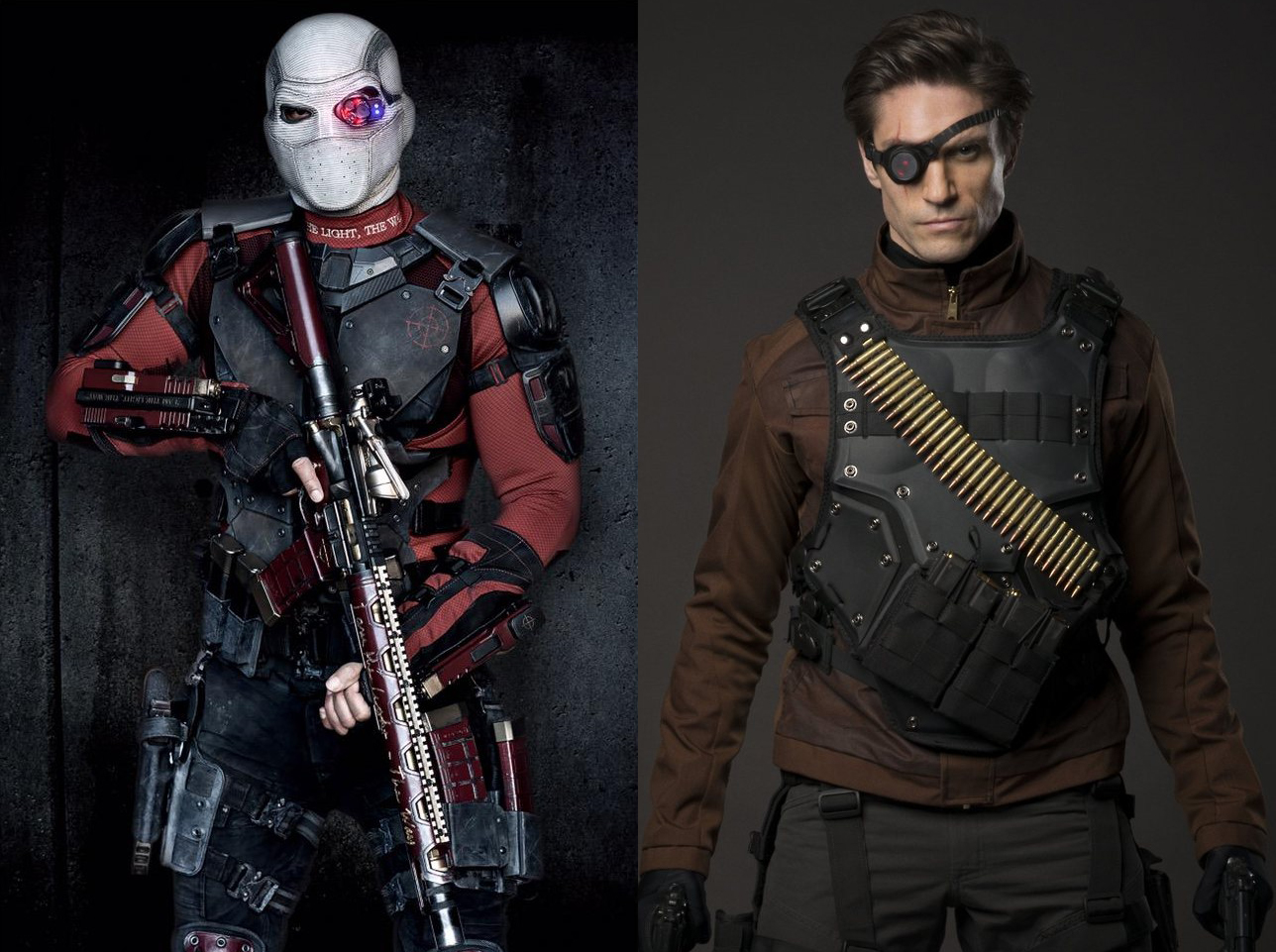
Clearly they are the same, therefore I am confused on how to take in the media. Sorry Warner Bros.

Clearly they are the same, therefore I am confused on how to take in the media. Sorry Warner Bros.

This spreads out to other obvious characters such as Batman, Superman, and Wonder down to characters like Harley Quinn. It even goes as far as to spread to characters that haven’t even be slated for a film yet. In season three of Arrow, we are introduced to Ray Palmer a.k.a. The Atom. This was originally intended to be Ted Kord a.k.a Blue Beetle but because Warner Bros. might have plans to use him in a film he was not permitted to appear on the show.

Now, with the premiere of Supergirl, Warner Bros. is sticking to their plan of avoiding all “brand confusion” by only mentioning Kara Zor-El’s cousin and vaguely showing Superman blocked by sunlight. Obviously, whoever plays  Superman on the new CBS show would be confusing to those watching Batman v. Superman: Dawn of Justice. The audience might say “Hey, wait this guy look different from this other guy,” because no one else has played Superman before. Oh wait:

I'm so confused.

I’m so confused.

The worst part is that they’re not even consistent. Blue Beetle and Booster Gold both appeared in Smallville with the latter also having a prominent role on Justice League Unlimited. Development for a Suicide Squad film began as far back as 2009 yet they allowed Deadshot not only to appear in Arrow, which wouldn’t premiere for three more years after, but also in Batman: Assault on Arkham along with Harley. Harley appears in all three of Arkham games developed by Rocksteady along with the Joker. The first game in that series came out the year after Heath Ledger appeared as the Joker in The Dark Knight. No brand confusion there.

The most prominent example of this is CW’s The Flash premiering while they’re simultaneously announcing Ezra Miller being cast as The Flash for the movies. How is this not an example of “brand confusion?” Warner Bros. makes the announcement just as their Flash TV series is beginning.  You might be asking, “what if this is DC learning their lesson?” but you have to remember that this announcement was made before Arrow was forced to kill off their version of Deadshot because of the Suicide Squad film.

Marvel, on the other hand, has no problem having multiple version of their characters in film and television. They seem to be doing just fine. For writers of fiction, one of the basic rules of storytelling that is taught is never to treat your audience like their idiots. Warner Bros. needs to learn this lesson before their audience gets tired of being talked down to.

Changing the Dark Tower V: The Final Book and Modred: All Hype, No Substance.

When those doors open to the Dark Tower at the end of Stephen King’s final volume the journey for Roland and his Ka-Tet will come to an end. The journey, however, is not without its hiccups and so here are some suggested changes for the “The Dark Tower VII: The Dark Tower.”

My posts on “The Wolves of the Calla” and “The Song of Susannah” focused more on criticism rather than changing those volumes. Most of the changes of “The Wolves of the Calla” are the result of changes in earlier novels, like introducing Father Don Callahan in an earlier book. With “The Song of Susannah” the changes suggested were cutting and pasting bits from “Wolves of the Calla” for the beginning, and the beginning of this final novel for the end. This would give the sixth book a more coherent story from beginning to end. Now let’s talk about the beginning of this novel. Obviously, there will be spoilers.

Continue reading

When the Audience is Bored of A-Listers, The B-Listers Will Inherit the Superhero Movies.

For an indeterminate amount of time, comic book fans have been ranking their heroes (and villains) like celebrities with  “A” through “D” rating.

In DC Comics Batman, Superman, and Wonder Woman have always been A-List heroes. However, characters like Green Lantern, The Flash, and Aquaman have fluctuated, falling to B-Listers in the 90’s, then rising again to A-listers in the mid-oughts.

Marvel is a bit stranger. In the early oughts, Brian Michael Bendis disassembled the Avengers for a good reason. Iron Man, Thor, and Captain America struggled as B-Listers in the late 90’s. Thor had been killed off, Iron Man was turned into an alcoholic and then a teengager  and Captain American in general seemed directionless. The rest of the Avengers just didn’t have the popularity of their other franches.  Marvel spent years building the Avengers back up to A-List characters, and thanks the  X-Men and Spider-Man being licensed to other film companies they had no choice but to build a movie universe on the back of the Avengers.

If they had owned the licenses for those two powerhouse franchises, Iron Man would not have been the first cinematic universe film under their own film company. They took a character, Iron Man, which the mainstream audience did not know and turned him into one of the biggest characters they currently have. They did it again with Guardians of the Galaxy, which people knew even less than Iron Man. Likewise, 2003’s Daredevil was an embarassment as far as movies go but Marvel took the franchise and turned it into the most watched and highest rated show on Netflix.

By regaining, rebooting, and revitalizing the Spider-Man franchise they’re also pushing back the inevitable. Marvel knows this, that’s why movies like Doctor Strange, Black Panther, and Captain Marvel were merely pushed back rather than replaced by Spider-Man movies. Then, with the rest of the Defenders series on Netflix they’ll turn Luke Cage, Jessica Jones, and Iron Fist into characters people know essentially raising their ranks from B and C-Listers into A-Listers. They took a character like The Vision and made him the most standout character of Avengers: Age of Ultron. They took a character like Ant-Man and made a entertaining and successful movie about him, which some people found laughable when announced.

On DC’s side it is a bit more worrisome, as far as movies go. Thanks to the success of Christopher Nolan’s Dark Knight Trilogy, Warner Bros. believes the grim and gritty approach is the way to go as far as their own cinematic universe goes as evidenced by their dark approach to Superman in Man of Steel, the trailer for Batman v. Superman, and Suicide Squad. This may work at first, but the novelty of it will end quickly. What makes The Flash television series so refreshing is how far away from the Batman tone it is. It’s optimistic, funny, light hearted, and colorful. No dreary colors, no over serious faces, and 90% less angst.

The novelty of Suicide Squad, and Batman v. Superman has a problem. If it wasn’t for Harley Quinn and Wonder Woman the appeal of these movies is what they’re doing differently with Ben Affleck’s version of Batman, and Jared Leto’s version of the Joker. This’ll only last so long. They need movies with different tones with different characters. If they try to Batmanify characters like Green Lantern, Wonder Woman, Martian Manhunter, and Aquaman (which is what it looks like they’re doing anyway) people will become fatigued. Marvel realizes an Iron Man movie should not have the same tone as a Captain America movie, but does Warner Bros. realize that?

The B-Listers will eventually inherit the Marvel movies but if Warner Bros. relies too much on the success of Batman to see what is unique about their other characters they’ll be doomed to fail before they even begin.

You Should Read: The City Stained Red by Sam Sykes & Rat Queens by Kurtis J. Wiebe (A double.)

This is a double You Should Read, a feature that is mostly in my drafts folder more than actually published in my blog. A lot of the time it’s because I’m not sure what I want to say about a book besides “This story blew my mind / was awesome / was cool / so good that I wish I could write like this!” and that doesn’t make much for a blog post.

Continue reading

Love “Game of Thrones?” Thank “unfashionable” Tolkien and C.S. Lewis, who went against the grain and conquered pop culture (via Instapaper.)

“The Inklings were different. They clung by their fingernails to the past, to old languages and old books and old-school habits and values. They could be cranky geezers — beer drinkers who wore tweed, refused to admit women to their ranks and recited Anglo-Saxon poetry for fun. They expected to be ever-more marginalized and sneered at, although they did fight like hell to keep Oxford from updating its syllabus to included such new-fangled entertainments as Victorian novels. Still, they assumed that they’d lose eventually. They were so unfashionable! So how did they end up taking over popular culture?”

“Yet Tolkien, and to a lesser degree Lewis, arguably have a bigger foothold in the early 21st-century imagination than Carroll, Wilde or some fictional police inspector. Why should that be? Surely one of the best explanations so far has been advanced by the academic and Tolkien scholar T.A. Shippey, who believes that Tolkien drew forth the long-submerged mythic past of the Anglophone world by means of his deep, historical knowledge of the English language.”

“The standard sophisticated take on this fantasy is that it’s childish and escapist, that it posits a past that never existed. And that’s true — Tolkien, who regarded the modern, industrialized world as a hellscape ravened by soulless machines (he hated cars), happily copped to the escapism bit. “Why should a man be scorned if, finding himself in prison, he tries to get out and go home?” he retorted.”

“Is it any wonder, then, that it isn’t the modernists, those poets of disintegration and speed and fleeting solitary experience, that readers keep returning to, but these fusty holdouts and abstainers, the guys who said, “We’d prefer not to”? Being Christian was just one of their ways of putting on the brakes, and it’s far from obligatory — let alone the central secret to their appeal. None of us gets to live in the Shire, but we haven’t lost our appetite for the kind to stories that are told there. Those stories are still the ones that feel the most like home.”

Love “Game of Thrones?” Thank “unfashionable” Tolkien and C.S. Lewis, who went against the grain and conquered pop culture

May 31, 2015 at 04:08PM

via Instapaper http://ift.tt/1JgxAZo

My Introduction to Lore: The Legend of Zelda.

Recently I read this article by Phil Owen on io9 titled I Care About Star Wars Because It Introduced Me To ‘Lore.’  In it he says:

“For me and many other fans, Star Wars is not a series of movies but a setting, a place. And Star Wars was the first property I enjoyed growing up where should I want more stories in its settings I could always have them. And it wasn’t a case of, as it is in many game franchises praised for having lots of lore, characters in a book telling us about past events or info in a codex — nearly all the lore was in books or comics somewhere.”

And I thought, “yeah, Star Wars was definitely the first time I cared about the world of a property beyond its main storyline. That was until I received this in the mail:

Master Sword, yo.

The Legend of Zelda: A Link to the Past Graphic Novel by Shotaro Ishinomori.

This is a graphic novel, a reprint of a comic that was both printed in Nintendo Power then collected into a paperback in the 90’s. I found the paperback version shortly before The Legend of Zelda: Ocarina of Time came out.

Continue reading