Impressive worldbuilding from Saladin Ahmed’s Throne of the Crescent Moon

Throne of the Crescent Moon by Saladin Ahmed.

Throne of the Crescent Moon by Saladin Ahmed.

Here’s a book recommended to me by Keri, a longtime fellow book buyer who also recommended to me three of my favorite modern day fantasy books that I just read this past week. I honestly didn’t know what to expect from Throne of the Crescent Moon by Saladin Ahmed.

As someone whose main interest is medievalism and fantasy I’m so used to that being the background for worldbuilding in epic fantasy books. So when I read this I was surprised to find it based on Arab and Middle Eastern culture which now seems so obvious as a rich source for worldbuilding that I am surprised it isn’t done more. Maybe it has and I’ve just not yet discovered those books.

The worldbuilding is where this book shines. The magic system is diverse, from the brief glimpse we get of it requires both vocal and written incantations. The types of monsters called ghuls which are raised from different elements including sand, water and skin ghuls. What stands out the most is the main city of Dhamsawaat brought to life by block names, class of people, merchants, factions and of course the royal palace of the Khalif which contains the titled Throne of the Crescent Moon.

The main characters, Doctor Adoulla Makhslood, Raseed bas Raseed, Zamia, Dawoud and Litaz all get points of views which really brings them to life as we get the inner workings of their struggle switching without delaying the action. Each one has both an inner and outer struggle you get to know and understand while also developing the relationships between the characters by letting us know what they think of one another. I think of George R.R. Martin’s A Song of Ice and Fire with each point-of-view chapter having a cap off at the end of each chapter. What Ahmed does is switches point of view from one chapter to the next in the middle of action. Just as an example Adoulla could be fighting a ghul with Raseed and be cornered and outnumbered then immediately the next chapter we get Raseed’s point of view as he tries to save his mentor.

The themes that come out in the book that I thoroughly enjoyed because of the switching point of views is the dynamics of age and youth, piety and apathy, experience and naievity. Adoulla, Dawoud and Litaz are much older having had their adventures together for many years. Their reaction to society is less rigid, more open minded as they’ve seen much of the world. Adoulla is very much a cynical old man wishing to retire viewing the established ruling power as incompetent if not corrupt. Zamia and Raseed both have a very rigid view of the world with very little experience of other cultures and ideas. Raseed because of the religious order and Zamia because of her tribe follow a strict set of rules that has been taught to them without questioning if those rules may be wrong or right in a given situation.

Where the novel is weak is in it’s plot development. The middle section after the setup of the conflict takes so long to gather the allies, uncover the secrets of their enemy and develop the plan only for the climax to be over in a blink of an eye. It never gets slow, only because by the time you’ve read the middle section you’re enthralled by the characters. You want to know more about them even when the plot isn’t advancing. The other weak part is the villain himself who we learn almost nothing about except for his name. Then when we finally meet him he barely speaks and is defeated in the blink of an eye after one of the characters finds his inner strength to overcome his self-doubt caused by the villain’s magic. His second in command does all the dirty work and gets the most development through exposition.

Does that seem harsh? I’m not sure but I would still recommend this book despite the little bit of shortcomings. I’m looking forward to the second novel The Thousand and One and how he’ll bring his main cast of characters back together.

In Praise of The Hobbit Illustrated by Jemima Catlin.

Recently, I purchased a new edition of J.R.R. Tolkien’s The Hobbit illustrated by Jemima Catlin thinking hey, this might be a great version to read to my nephew in the future or my kids if I decide to have any. I was taken aback when my copy arrived in the mail on Saturday.

20140602-214638-78398108.jpg

The Illustrated Hobbit


You can’t discern it from the photo but this edition is heavy. Not heavy like a big leather bound version of The Lord of the Rings but more like a children’s book that would endure the abuse of being carried around by a child.

To claim our long forgotten goldddddddd.

The cover is flecked with gold bit that shine in the light.

Not just in the title but in the tree Bilbo is leaning and and the animals on the right is bits of gold that really makes the cover stand out. The outside of the cover feels like felt, soft like a stuffed animal.

The Green Door of Bag End.

In a hole in the ground there lived a hobbit.

Each chapter begins with an illustration like this. I must admit this is one of my favorite illustrations of the green door of Bag End.

"Who spilled ale on the map, who was it? huh?"

Let’s have no more argument. I have chosen Mr. Baggins and that ought to be enough for all of you.

Larger illustrations like this are sprinkled throughout the chapters. What I enjoy about, and this is no way a jab at Peter Jackson or Alan Lee (who a lot of Peter Jackson’s designs and looks are based on) but I am glad all the characters don’t just look like imitations of the movie versions.

Take that, words!

Considering The Hobbit, or There and Back Again as Bilbo names it, is actually written about Bilbo some people believe the stone giants were in fact made up by him.

Then in pages like this, with the battle of the stone giants, it spreads over the pages as if the words of the book are in the story itself. This similarly happens in the scene with Gandalf lighting the pinecones and throwing them at the wargs.

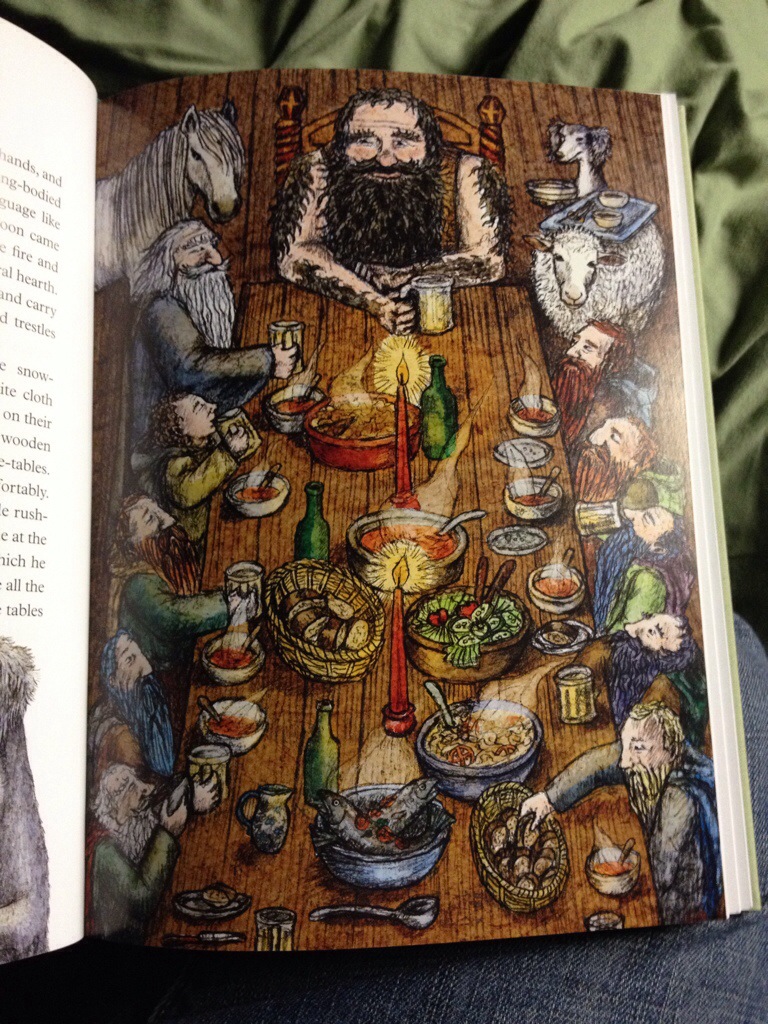
Beorn to be wild.

So soon they were all seated at Beorn’s table, and the hall had not seen such a gathering for many a year.

Then full page illustrations like this are done for big moments in the books like say, meeting a sleeping dragon. I’m not going to spoil that here as it is a nice surprise when you see it.

This isn’t a review of The Hobbit. I mean, the text is exactly the same as it is in any other volume of The Hobbit, except maybe The Annotated Hobbit. Where this volume stand out is the illustrations. If I were a teacher, this would be the volume I’d read to my kids to introduce them to the world of Middle-Earth and fantasy fiction. If I were a parent of a young reader this would be the volume I’d give them for Christmas or their birthday.

The binding is quality material, beautiful yet durable. The illustrations are beautiful yet still approachable for children and the story is of course a brilliant faerie (in the traditional sense of the realm of the fays) tale.

Movies will never be books, and TV too.


If you’re reading this, it is safe to say you are living in the 21st Century. I don’t imagine this blog will find its way in any century besides this one. Therefore, you most likely have some experience with novels, television shows, and movies.

     Anyone who has ever had a favorite book or merely just a book they were the slightest bit fond of has an understanding of the adaptation whether it’s for television or the theater.
     Adapting novels to a visual medium isn’t anything new and it isn’t limited to movies and television but what I am focusing on here is the adaptation in the age of information.
     It seems like people often believe Hollywood has not experienced economic turmoil with the rest of us over the last thirteen years. You read about these ridiculously high numbers going to the cast’s salary, the budget, and at the box office and it’s more money than most people have ever had in their life. However, like the rest of, film studios have had to adjust to rising cost of, well, everything along with dealing with people’s expectations of what a movie should look like.
     Along with dealing with this they’ve had their struggle adjusting to the digital age. The way in which we are able to watch film and television has drastically changed in the last thirteen years as evidenced by the Netflix or other service streaming on your television, desktop, laptop, smartphone, or tablet.
     This is no way a defense for the film industry as I’m sure they’re lobbying for the next version of CISPA and SOPA, a tactic to control the chaotic frontiers of the internet out of fear of piracy instead of adjusting to change. It does, however, help explain the rise of the franchise.
     The first year of the 21st Century saw two film franchises begin based on very popular books. Harry Potter and the Sorcerer’s Stone and The Lord of the Rings: The Fellowship of the Rings were both highly ambitious adaptations setting precedents with their production, presentation and box office sales.
Alongside this, the superhero franchises are just beginning their rise with the likes of X-Men and Spider-Man. The success of these films displayed you could establish franchises in genre fiction that wasn’t there before, as well as adapting what previous generations of Hollywood filmmakers deemed “unfilmable.”
So we have…

  • Hit series of films based on a book and comic books in Harry Potter, The Lord of the Rings, X-Men, and Spider-Man.
  • New technology in special effects including but not limited to CGI
  • Economic turmoil increasing the cost of production of movies.
  • Ease of access to information through innovation in higher speed internet and the rise of desktop computers, laptops, smartphones, and tablets.

All of this blended together leads to what we’ve seen in Hollywood the last thirteen years and beyond. Books and comic books to an extent have an established audience and likewise so do sequels. Why take a risk on an original script when adapting a series of books proven to sell on the New York Times Bestseller Lists is a much lower risk?
So here we are, watching our favorite books become movies step by step. With a few taps of the keyboard and a few clicks we know who bought the films rights, who is writing the script, who is directing, who is cast as the main character, what the costumes will look, what changes the story were made. Change is the keyword here, a common fear amongst everyone, not just exclusive to book adaptations either.
Here’s the thing fellow bibliophiles and regular readers, Movies will never be books and TV too. You all know the inner monologue is the first things to go when it comes to the adaptation, but it isn’t the last.  With books, there is no limit to the imagination but with film and television there is nothing but limits that often are stretched much further than deemed possible by the filmmakers themselves.
Money, is, of course, the number one limit to the adaptation of a book. Everything has a financial limit and this often leads to sacrifices. Sacrifices that have a cost to the storytelling as well. There might be the technology to pull off that epic battle scene in your favorite novel, there might be the perfect actor who fits exactly what the protagonist looks like and sounds like, and there might be the perfect director who loves the script, loves the novel and always imagined bringing its world to life. None of these factors are free, though, there’s a reason writing novels isn’t called the novel business but making films is called the movie business.
None of these people are going to be free and sometimes sacrifices are going to have to be made in order to get one of these factors over another. You may have to settle for the second choice actor in the film in order to get the special effects budget you need or, on the other hand, you get the actor you wanted but that battle scene needs to be scaled down.
There are so many factors that could go wrong on a movie. In filmmaking you are lucky to get your movie made, for it to be any good, and then for it to be successful which is what an adaptation of a series needs in order to make books two through the final book.
These all difficult and daunting tasks that don’t necessarily happen for the majority of movies. Scripts get multiple writings and revisions by writers who are usually not the author of the original novel, all of with their own takes, voices, and perspectives that they are trying to convey through someone else’s story. There’s no guarantee that these writers are passionate about the novel they are transferring to film. The same goes for the director, the actors, the producers, and the studio distributing it.
My advice to readers? Let go. You can’t think of film or television version of the novel as the visualization of the novel. Corey Olsen, also known as The Tolkien Professor broke it down fairly for readers when discussing The Hobbit: An Unexpected Journey on an episode of his podcast, Tolkien Chat 12: Adaptation and the Hobbit Movies when discussing film adaptations that you can apply to TV as well.

I’ve often said a movie is different from a book. The first thing you have to keep in mind when you are going to see a film adaptation of a book is you’re not going to see a book on screen and it’s not fair to evaluate the thing you are seeing as if it were simply a transposition of the book on screen. It’s not a translation. It’s an adaptation. It’s a retelling. This is another version of the story. This is not Tolkien. This is Peter Jackson’s retelling of Tolkien’s story on screen and those are two different thing. You have a different person telling the story and you have a different medium in which the story is being told.

Believe me, I understand. One of my favorite books is the Hitchhiker’s Guide to the Galaxy and the film version failed to capture the satirical intelligence of Douglas Adams writing but these are not sacred text and as long as they keep making money Hollywood will continue adapting books to film. Your favorite book will still be there even if you don’t like the retelling of it in the film. The book was better,