Late to the Party: Joe Abercrombie’s The Blade Itself.

As far as book go, it isn’t often that I have the forethought or the word on the street to get in on the ground floor of an author or series of novels. Joe Abercrombie is no exception.

I bought the first book in his The First Law trilogy after pre-ordering his new book Half A King. Once I start reading The Blade Itself my first thought was that I have should have read this years ago. Eight years later I’ve finished the first book and I want to read the second book right away. This is highly irregular for me.

I don’t know what it is but I can’t read the second book of a series immediately after reading the first. I get distracted, I get bored, I lose focus, my eyes start to trail off and by the end I can’t remember what really happened. I’m going to be clear: this is a not a slight of the quality of the novels but a flaw that I have. Just look at this list of second books I’ve tried to read immediately after the first and either didn’t enjoy it as much or since discovering this flaw about myself, stopped reading to pick up another time.

  • A Clash of King by George R.R. Martin
  • The Wise Man’s Fear by Patrick Rothfuss
  • Red Seas under Red Skies by Scott Lynch
  • The Well of Ascension by Brandon Sanderson
  • Kill the Dead by Richard Kadrey
  • The Restaurant at the End of the Universe by Douglas Adams

I can recall my experiences with all these books. You know when you read the words but don’t really take in what they’re saying? That happened to me with A Clash of Kings and The Restaurant at the End of the Universes? One, I missed hints to major plot points that would come in future books and the other I was too bored to enjoy Adam’s delightful sense of humor.

I think with The Wise Man’s Fear I got the furthest before putting it down, maybe a hundred pages? This was around the time that I was discovering this flaw about myself and I loved The Name of the Wind so much that I didn’t want the experience of the second book to suffer. With Kill the Dead, the second book in Kadrey’s Sandman Slim series I read the first page, could feel my restlessness settle in and immediately put it down.

Now, Red Seas under Red Skies I remember putting down for maybe a month or two before I had to pick it up again in order to keep up with a friend who was reading, a much faster read than I am. Same thing happened with The Well of Ascension the year before and my opinion of the Mistborn series as a whole suffered for it. That book was torture for me to read through, I found it slow, I found the main character Vin to be a whiny idiot who made the worst decisions and by the end I didn’t care about anything that was happening. I just wanted to finish and when I did I didn’t bother picking up the third book even though my friend had already gotten halfway through it. That was December of 2012 into January 2013 and only now have I even started the third Mistborn book, The Hero of Ages. Guess what? I actually am enjoying despite the sour taste the second book left in my mouth. 

There are of course exceptions. If I read The Lord of the Rings I can read all three front to back with no qualms. Sometimes I’ll just read one only because I have read them so many times and want to read something new but the point is I can read all of them front to back without getting that restless feeling. Same thing happened with most of Stephen King’s The Dark Tower series. It wasn’t until the fourth book that I got restless and even then I only read one book in between before reading book five, six and seven.

The point of all this is that I want to read Before They Are Hanged, the second The First Law book right now. I need to know what happens to the characters now rather than later. I want to know more about the world, about it’s past and what is going to happen next. If an author can get me to do that then the books must be damn good.


What is Tom Bombadil’s significance? The answer from J.R.R. Tolkien himself.

“Tom Bombadil is not an important person – to the narrative. I suppose he has some importance as a ‘comment’. I mean, I do not really write like that: he is just an invention (who first appeared in the Oxford Magazine about 1933), and he represents something that I feel important, though I would not be prepared to analyze the feeling precisely. I would not, however, have left him in, if he did not have some kind of function. I might put it this way. The story is cast in terms of a good side, and a bad side, beauty against ruthless ugliness, tyranny against kingship, moderated freedom with consent against compulsion that has long lost any object save mere power, and so on; but both sides in some degree, conservative or destructive, want a measure of control. but if you have, as it were taken ‘a vow of poverty’, renounced control, and take your delight in things for themselves without reference to yourself, watching, observing, and to some extent knowing, then the question of the rights and wrongs of power and control might become utterly meaningless to you, and the means of power quite valueless. It is a natural pacifist view, which always arises in the mind when there is a war. But the view of Rivendell seems to be that it is an excellent thing to have represented, but that there are in fact things with which it cannot cope; and upon which its existence nonetheless depends. Ultimately only the victory of the West will allow Bombadil to continue, or even to survive. Nothing would be left for him in the world of Sauron.”

– J.R.R. Tolkien from The Letters of J.R.R. Tolkien; Letter #144

The Magic of Middle-Earth is Unexplainable, Nor Should It Be.

For this is what your folk would call magic. I believe; though I do not understand clearly what they mean; and they seem also to use the same word of the deceits of the Enemy – Galadriel


“Faerie itself may perhaps most nearly be translated by Magic—but it is magic of a peculiar mood and power, at the furthest pole from the vulgar devices of the laborious, scientific, magician. There is one proviso : if there is any satire present in the tale, one thing must not be made fun of, the magic itself. That must in that story be taken seriously, neither laughed at nor explained away.” – J.R.R. Tolkien, On Fairy Stories.

This video has been gaining traction today detailing how Legolas could not really see as far as he claims according to the laws of physics. This is a common occurrence when it comes to the fantastical things in Tolkien’s Legendarium. The problem is that Tolkien’s magic cannot be explained using a set of rules. It is more mythical and mysterious like the folk tales of Anglo-Saxon, of Norse sagas, Arthurian romance and probably the Old Testament.

I can’t believe I have to explain this but magic isn’t science, it doesn’t have to be explained. It can be, and that can be fun too. Brandon Sanderson is known for his magic systems. He even has what he calls Sanderson’s Laws for his series of rules when creating magic systems. Patrick Rothfuss goes to painstaking details to create rules for his magic system. Then comes naming. Naming cannot be explained like love, humor or music yet no one gives Rothfuss any guff trying to explain the rules of naming.

My point is you can have a magic system in a fantasy book that does not have rules and the work of J.R.R. Tolkien is a prime example. The problem is that “magic” in Middle-Earth is what men and hobbits calls thing they cannot explain leading to reactions like the Galadriel quote above. “Magic” is part of Arda (the earth) itself and the elves are connected permanently to Arda. What we as readers such as men and hobbit may see as magic the elves see as a natural part of their skills and their very being. It is more of a divine power with few explanations to how it really works.

Here is where critics start throwing out words like Deus ex machina without fully understanding what it means. What makes Tolkien’s works have that mythical feeling about them is that there are aspects that cannot be explained such as the elves, the wizards, Balrogs and beings like Sauron.

Partially to blame is Hollywood, Peter Jackson’s The Lord of the Rings trilogy and films in general. Those are visual mediums, as such they need visuals to convey what is going on. The problem is magics is not all visual in any of Tolkien’s books. While the film showed forcefields and battles of light coming from his staff and slashes of his sword versus the Balrogs swipes and cracks of his whip the fight in the books is more of a battle of wills, a battle of power between to divine beings that we cannot see with barely any swordplay.

The Balrog reached the bridge. Gandalf stood in the middle of the span, leaning on the staff in his left hand, but in his other hand Glamdring gleamed, cold and white. His enemy halted again, facing him, and the shadow about it reached out like two vast wings. It raised the whip, and the thongs whined and cracked. Fire came from its nostrils. But Gandalf stood firm.
‘You cannot pass,’ he said. The orcs stood still, and a dead silence fell. ‘I am a servant of the Secret Fire, wielder of the flame of Anor. You cannot pass. The dark fire will not avail you, flame of Udûn. Go back to the Shadow! You cannot pass.’
The Balrog made no answer. The fire in it seemed to die, but the darkness grew. It stepped forward slowly onto the bridge, and suddenly it drew itself up to a great height, and its wings were spread from wall to wall; but still Gandalf could be seen, glimmering in the gloom; he seemed small, and altogether alone: grey and bent, like a wizened tree before the onset of a storm.
From out of the shadow a red sword leaped flaming.
Glamdring glittered white in answer.
There was a ringing clash and a stab of white fire. The Balrog fell back and its sword flew up in molten fragments. The wizard swayed on the bridge, stepped back a pace, and then again stood still.
‘You cannot pass!’ he said.
With a bound the Balrog leaped full upon the bridge. Its whip whirled and hissed.

Neil Gaiman has a great quote about magic in film when talking about the film adaptation of A Winter’s Tale which by the way is a terrible movie mostly despite his warm review of it.

There’s a thing that happens in Hollywood, when you hand in a script with magic in it, and the people at the studio who read it say “We don’t quite understand… can you explain the rules? What are the rules here? The magic must have rules” and sometimes when they say that to me I explain that I am sure it does, just as life has rules, but they didn’t give me a rule book to life when I was born, and I’ve been trying to figure it out as I go along, and I am sure it is the same thing for magic; and sometimes I explain that, yes, the magic has rules, and if they read again carefully they can figure out what they are; and sometimes I sigh and put in a line here and a line there that spells things out, says, YES THESE ARE THE RULES YOU DON’T ACTUALLY HAVE TO PAY ATTENTION and then everyone is very happy. 

I understand, I really do. It seems frustrating because we live in a world of science that strives to explain how the universe works and that can be beautiful but Middle-Earth isn’t our world. It is a epic myth such a The Odyssey, The Prose Edda, The Arthurian Legends and Beowulf. The problem is people still come along and try to explain it or disprove parts of it.

The other problem that pertains to the video about Legolas’s eyes is the perceptions that elves are just some kind of different humanoid type species. Elves are preternatural beings, outside the rules of nature yet also connected to nature itself. This comes from the Tolkien Gateway entry on elves under arts, crafts, powers and magic.

Other races often spoke of ‘Elf magic’, or of objects made by Elves as if they contained enchantments. It is unclear how accurate it is to call Elvish arts and crafts ‘magic’ or ‘enchanted’. Elves themselves only used these words when attempting to simplify or clarify how elvish-made things seemed to have a special quality that no other races were able to achieve. Powerful Elves seemed to have control over nature and the elements, their clothes seemed to shine with their own light, their blades seemed to never lose their sharpness. Less educated folks couldn’t explain these effects, so they simply called them ‘magic’. However, each race had their own special abilities that seemed incomprehensible to others. Hobbits had a seemingly supernatural ability to hide when they wished to remain unseen. Dwarves were unmatched in the art of mining and building halls underground. Wizards had such wisdom and knowledge of the world and all things in it that they appeared to have mystical powers. To each of these races, what they did had nothing to do with magic, it was just how they did things. It may have been so too with Elves. Whether there was any kind of mystical energy involved in the things Elves made can never be proved or disproved.

N.K. Jemisin who wrote the Inheritance trilogy wrote this great article for io9.com just on the subject of magic and rules titled Why does magic need so many rules? In it she makes a connection of what might be the blame for why modern fantasy readers and viewers need rules for magic in Dungeon and Dragons which has rules clearly defined using systems of numbers. Why stop there though? What about video games which also when it comes to magic has a system in place for how magic can be done but Jemisin argues…

It’s supposed to go places science can’t, defy logic, wink at technology, fill us all with the sensawunda that comes of gazing upon a fictional world and seeing something truly different from our own. In most cultures of the world, magic is intimately connected with beliefs regarding life and death – things no one understands, and few expect to. Magic is the motile force of God, or gods. It’s the breath of the earth, the non-meat by-product of existence, that thing that happens when a tree falls in the forest and there’s no one around to hear it. Magic is the mysteries, into which not everyone is so lucky, or unlucky, as to be initiated. It can be affected by belief, the whims of the unseen, harsh language. And it is not…


In LotR, sometimes magic meant forging a ring with a chunk of soul melted into the alloy. Sometimes it meant learning obscure/dead languages, or talking to obscure/dead creatures. Sometimes it meant brandishing a particular kind of stick in a particular kind of way, and shouting really loudly. Sometimes it meant being born with pointy ears, and sometimes resisting magic meant being born with hairy feet. It was organic, embedded, a total crapshoot. And it was wonderful.


The point is, magic can have a system of rules such as Brandon Sanderson’s Mistborn series or Patrick Rothfuss’s Kingkiller Chronicles, hell, my own fiction has a system of magic but quit trying to find fault in Tolkien’s magic system because magic doesn’t always need so many rules.

In Praise of The Hobbit Illustrated by Jemima Catlin.

Recently, I purchased a new edition of J.R.R. Tolkien’s The Hobbit illustrated by Jemima Catlin thinking hey, this might be a great version to read to my nephew in the future or my kids if I decide to have any. I was taken aback when my copy arrived in the mail on Saturday.

20140602-214638-78398108.jpg

The Illustrated Hobbit


You can’t discern it from the photo but this edition is heavy. Not heavy like a big leather bound version of The Lord of the Rings but more like a children’s book that would endure the abuse of being carried around by a child.

To claim our long forgotten goldddddddd.

The cover is flecked with gold bit that shine in the light.

Not just in the title but in the tree Bilbo is leaning and and the animals on the right is bits of gold that really makes the cover stand out. The outside of the cover feels like felt, soft like a stuffed animal.

The Green Door of Bag End.

In a hole in the ground there lived a hobbit.

Each chapter begins with an illustration like this. I must admit this is one of my favorite illustrations of the green door of Bag End.

"Who spilled ale on the map, who was it? huh?"

Let’s have no more argument. I have chosen Mr. Baggins and that ought to be enough for all of you.

Larger illustrations like this are sprinkled throughout the chapters. What I enjoy about, and this is no way a jab at Peter Jackson or Alan Lee (who a lot of Peter Jackson’s designs and looks are based on) but I am glad all the characters don’t just look like imitations of the movie versions.

Take that, words!

Considering The Hobbit, or There and Back Again as Bilbo names it, is actually written about Bilbo some people believe the stone giants were in fact made up by him.

Then in pages like this, with the battle of the stone giants, it spreads over the pages as if the words of the book are in the story itself. This similarly happens in the scene with Gandalf lighting the pinecones and throwing them at the wargs.

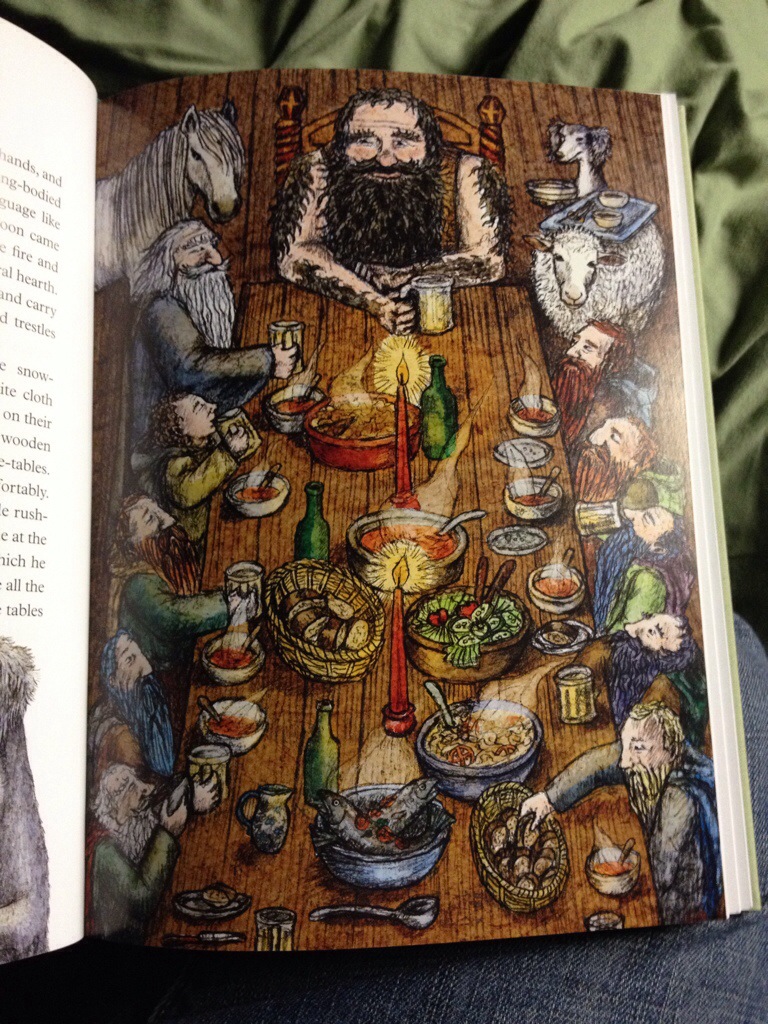
Beorn to be wild.

So soon they were all seated at Beorn’s table, and the hall had not seen such a gathering for many a year.

Then full page illustrations like this are done for big moments in the books like say, meeting a sleeping dragon. I’m not going to spoil that here as it is a nice surprise when you see it.

This isn’t a review of The Hobbit. I mean, the text is exactly the same as it is in any other volume of The Hobbit, except maybe The Annotated Hobbit. Where this volume stand out is the illustrations. If I were a teacher, this would be the volume I’d read to my kids to introduce them to the world of Middle-Earth and fantasy fiction. If I were a parent of a young reader this would be the volume I’d give them for Christmas or their birthday.

The binding is quality material, beautiful yet durable. The illustrations are beautiful yet still approachable for children and the story is of course a brilliant faerie (in the traditional sense of the realm of the fays) tale.

How will A Song of Ice and Fire / Game of Thrones end? (No spoilers)

With two books to go by the self-admitted slow writer and the producers of the HBO show estimating the series to end at eight seasons the end game for A Song of Ice and Fire / Game of Thrones is far off. Still, I know how it will end, at least I know how viewers will perceive it to end. There will be no spoilers beyond conjecture, and no details of the fates of any characters.
The hype machine is still going strong for this series, with George R.R. Martin’s name constantly in the news, making appearances on Conan and casting confirmations as well unofficial filming footage constantly hitting the sites centered around pop culture. The show’s intention with each season is to build upon the overall arcs of each character with some ending as the seasons go on. The books likewise, because of the way they tell stories using third person limited point of view for different characters in each chapter, tell the stories of said characters as part of any overall story Martin is building towards.
Recalling an article from io9 speaking of Game of Thrones scratching that mystery itch that was left in the wake of Lost brings up the disappointment many felt by the end of series over the ending as it left questions unanswered and the overall conclusion deemed disappointing. Martin himself has said his intention is to avoid a Lost-like ending, proclaiming his disappointment and his hope to deliver on the high expectations of his fans. However, he also expects the ending to be bittersweet.
This is just conjecture but just as the story was inspired by the image of the two dying animals in the first episode and the first book, I expect Martin has had the ending in mind from the very beginning with obvious editing needing to be done as the plot changes and characters are added. While I’ve always expected a bittersweet ending given that the story for the majority a tragedy how satisfying will that ending be to it’s viewers and it’s readers? Let’s avoid questions of a production nature like it’s budget, it’s directing, the cinematography, the acting, etc and just explore it from a storytelling perspective.
Game of Thrones and the even more so the books it’s based on is a world full of characters. With this many characters the odds of satisfying every consumer is slim, but that is to be expected. Every character is someone’s favorite character including the antagonists but not every character is slated to have a complete story-arc as some of the secondary ones are doomed to be metaphorical and sometimes literal causalities to the major point of view ones. If we break it down even further using just the main characters we can expect that when they all converge once again as they did in the beginning of the series that some of these characters will come into conflict. As this is in a sense a political tragedy most of the characters fall into a morally gray area rather than one group being good and the other evil. Therefore, each character probably has a fanbase that’ll be disappoint and one that will be satisfied with how it’ll end overall.

How will it end though? I know how will it end in vague details, just going by what I’ve seen and what I’ve read from the source material plus Martin’s expectation of a “bittersweet” ending and his hope to avoid an ending like Lost. Here it is in the vaguest terms possible. Westeros will be left completely changed but stable in the political sense, not all the characters people hate will die and not all the ones people like will live. There will be sacrifices, sometimes that means a character’s life and sometimes that’ll mean a character’s power. 
Questions that have had speculation surrounding them will be answered with obvious answers and ones no one expected. Questions people didn’t know they should be asking will be answered, which in hindsight viewers will believe that should of been obvious. Questions that everyone has been wondering about for ages will never be answered because stories, like life, don’t have to answer all the questions. 
There will be love, sadness, tears, triumph, victory, tragedy, loneliness, isolation, and most likely satisfaction. Before it is over surely there will be fire and blood, you will hear some roar and some will pay their debts, there will be fury by some, sharp blades by others, and winter will most definitely come. 

A Year in Books 2013.

     You could just go to my Goodreads profile and see what I’ve read in 2013 by clicking “date read” under My Books, but where would the fun be in that? So here’s a list, in order, of what I read in 2013.

The Well of Ascension (Mistborn, #2) by Brandon Sanderson
The Magicians by Lev Grossman
A Feast for Crows (A Song of Ice and Fire, #4) by George R.R. Martin
Gun Machine by Warren Ellis
The Iceman Cometh by Eugene O’Neill
Long Day’s Journey Into Night by Eugene O’Neill
Embassytown by China Mieville
Spun & Bite: A Writer’s Guide to Bold Contemporary Style by Arthur Plotnik
A Streetcar Named Desire by Tennessee Williams
The Glass Menagerie by Tennessee Williams
Odd and the Frost Giants by Neil Gaiman
The Valley of Fear by Arthur Conan Doyle
Exploring J.R.R. Tolkien’s The Hobbit by Corey Olsen
The Player of Games by Iain M. Banks
Make Good Art by Neil Gaiman
To Kill A Mockingbird by Harper Lee
Harry Potter and the Order of the Phoenix by J.K. Rowling
Harry Potter and the Half-Blood Prince by J.K. Rowling
A Dance with Dragons (A Song of Ice and Fire, #5) by George R.R. Martin
The Ocean at the End of the Lane by Neil Gaiman
The Lies of Locke Lamora by Scott Lynch
The Name of the Wind by Patrick Rothfuss
The Writer’s Journey: Mythic Structure for Writers by Christopher Vogler
The Odyssey by Homer
The Fellowship of the Ring by J.R.R Tolkien
The Two Towers by J.R.R. Tolkien
The Return of the King by J.R.R. Tolkien
Aloha from Hell (Sandman Slim #3)
Laughter: An Essay on the Meaning of the Comic by Henri Bergson
Lysistrata by Aristophanes
Menaechmi by Plautus
Tartuffe by Moliere
Much Ado About Nothing by William Shakespeare
Red Seas Under Red Skies (Gentleman Bastard, #2) by Scott Lynch
The Republic of Thieves (Gentlemen Bastard, #3) by Scott Lynch
The Wasp Factory by Iain Banks
How Not to Write a Novel: 200 Classic Mistakes and How to Avoid Them by Howard Mittlemark
     This list doesn’t include the forty-two sources for my senior thesis. The largest disappointing read began in the beginning of the year with The Well of Ascension and The Magicians with both books leaving me hating the main characters by the time I finished them and have yet to pick up the follow ups. The biggest surprise was A Feast for Crows, which is notoriously hated by fans of George R.R. Martin for focusing on new or minor point of view characters but I still felt it was a strong book with events that’ll be important for the final two books.
     Easily the best reads I had this year, as far as new books I’ve read was Scott Lynch’s Gentlemen Bastard series starting with The Lies of Locke Lamora. A lot of modernist plays in my reading list this year, which I find myself loving despite disliking a lot of modernist poetry and novels.My rereads this year, The Lord of the Rings and The Name of the Wind continue to maintain their place as two of my favorite books, while Neil Gaiman’s new novel The Ocean at the End of the Lane did not disappoint despite it’s short length. 
     Despite my love for Warren Ellis’s writing, Gun Machine was your typical detective mystery in stark contrast to his previous novel Crooked Little Vein which I think I will reread this year. Discovering his podcast late last year, I had to pick up The Tolkien Professor, Corey Olsen’s book Exploring J.R.R. Tolkien’s The Hobbit which made me appreciate the children’s book a lot more. Embassytown by China Mieville is in my opinion his best book, exploring an alien race and language in a way I haven’t read in science fiction yet, though I know he isn’t the first to do so. Meanwhile, with the passing of Iain Banks I had to read two of his novels this year. The first one, his second Culture novel The Player of Games has easily become one of my favorite science fiction novels while The Wasp Factory was a disturbing look at rituals that I never would of thought of.
     Of all the writing books I’ve read this year I thought The Writer’s Journey would of come out as the best but with a second half that drags How Not to Write a Novel’s brevity as well as it’s hilarious way of showing bad writing made it the top writing book for me of 2013. I don’t have much to say about the Harry Potter series, I like the books as I read them and they are indeed fun books to read but that’s about where it ends for me, and To Kill a Mockingbird I don’t really need to comment on that always has been written before. The book and Atticus continue to be amazing. That was my 2013 in books.
     For 2014 in books I hope there books from my favorite authors are announced, to reread J.R.R Tolkien’s The Silmarillion, and to read ten more books than I’ve read in 2013.

Jackson’s The Desolation of Smaug expands Tolkien’s The Hobbit for Film

 
     The director of The Hobbit film trilogy expands the film version of Middle-Earth for it’s second outing. While some have called turning the children’s novel into a three part film a stretch, Jackson manages to flush out the Tolkien’s world and characters. In the second part of the film trilogy Jackson continues to do without the slow pace some critics complained about in An Unexpected Journey.

     Right out of the gate the hobbit, the wizard, and the thirteen refugee dwarves of Erebor are still on the run from Azog the Defiler and his orcs. From there the breaks in the action are very short transitioning from Beorn’s House to Mirkwood to Thranduil’s Kingdom to Lake Town to Erebor. Beorn himself and the encounter with the spiders receive the short shaft of this film sure to be expanded upon in the extended edition.
     The second film is far more removed from the source material, but in doing so Jackson makes a better film than the first one. Adapting literally means to make suitable to requirement or conditions and Peter Jackson does a wonderful job in this film. It is different from the book and in one of the rare cases this change made it a better movie than if they strictly stuck to it.
     While Thorin continues down his path to Shakespearean-like tragic hero, Bilbo’s characterization takes a step away from the books that was refreshing. Bilbo struggles with the power of the ring, Unlike Frodo, who has information about the ring during The Lord of the Rings, Bilbo has no idea there is an outside force working against him. This makes his struggle with the power he now has a more inner conflict he needs to work out. In that way, he becomes a better foil to Gollum’s struggle with the ring then Jackson tried to do with Frodo.
     What is highly interesting is Jackson’s depiction of where Gandalf went off to during the journey. Technically, Jackson and company cannot use any material from Tolkien’s other works other than The Hobbit and The Lord of the Rings that explains exactly what Gandalf was up to when dealing with the Necromancer. Instead, Jackson surprisingly skirts around the story depicting what happens differently while remaining as close as possible to how it Tolkien canon it actually went. This also gave him the opportunity to backtrack over his mistakes in The Lord of the Rings with his depiction of Sauron as a giant eye.
     Like the Riddles in the Dark scene in the first firm, the highlight of the second was easily Bilbo’s interaction with Smaug. Benedict Cumberbatch was the perfect choice to depict Smaug, which the trailers so far do no justice to how incredible of a dragon he is. Even the often criticised scene of the dwarves and Smaug together is enjoyable just to see more Smaug. The dwarves cowering outside of the Lonely Mountain as depicted in the book would not have worked for this film.
     Complaints of Tauriel’s inclusion will come unfounded as her addition add great dramatic conflict to Thranduil’s philosophy of withdrawal from the problems of the world. Legolas’ inclusion comes more into question as he remains there for pretty action scenes. Despite this, another criticised moment that was highly enjoyable was the barrel action scene depicting it in a fun way that shows off Legolas’ action and a good transition to Laketown what would otherwise be a slow moment.
     Laketown and it’s inhabitant was another expansion of the small scene in the book that served to make a better movie, as Bard the Bowman, The Master and the town itself are more flushed out to make a better conflict for the story. Overall, with a few minor quibbles like changing Bard’s ancestor from a king to a lord and the shortened scenes involving Beorn and the spiders of Mirkwood, The Hobbit: Desolation of Smaug is an example of a film where change is welcome.
     J.R.R Tolkien’s The Hobbit will still remain the way it is, and this film does no harm in highlighting what is great about the author’s creation.

How Faithful Are ‘The Hobbit’ Films to Tolkien’s Books? by Corey Olsen, the Tolkien Professor

The Desolation of Smaug Review by Aaron Diaz, author of webcomic Dresden Codak

Movies Will Never Be Books, and TV too! by Me

A Story about Three Other Stories

     Sitting outside in my parent’s backyard, I’ve just finished reading for the second time The Name of the Wind by Patrick Rothfuss when I realize it was the first book of a trilogy of books I had completely about twenty days ago with The Lies of Locke Lamora by Scott Lynch.
     Along with Elantris by Brandon Sanderson, these three books were all bought at the Smith Haven Mall’s Barnes & Noble. Since about 2007 my friend Keri and I have had a tradition where I pick her up from her house, we go to Barnes & Noble hunting down books to purchase, and then grab a bite to eat. All along the way, except for the moments when we’re hunting down books, we catch up on what’s going on in our lives.
     I can’t say we’re close friends but I also can’t say we’re not. We both have our own group of friends, jobs, and schools that keep our lives busy. I’ve been mulling it over as I drafted this blog entry on a legal pad, and I would compare our friendship to getting to hang out with that cousin at the big family barbecue, that cousin you have the most in common with but don’t get to see that often. You’re relieved to finally be able to talk to someone on a similar wavelength as you. Plus, with the amount of books she reads and the number of years she’s been writing I have always a new book she can recommend to me. Which is exactly what she did in this story.
     The stories goes, in I believe the summer of 2008 when we went on one of the trips to Barnes & Noble I was looking for something new in the genre of Fantasy. This was after I had absorbed The Lord of the Rings into my being, was heavily read in Science Fiction, was too smug with my Literature Major classes to read Harry Potter (I have since read 1-6 and highly enjoyed them) and had yet the foreknowledge to try George R.R. Martin’s A Song of Ice and Fire.
     So simply, I asked her “I’m looking for some fantasy books, more modern authors, something new.” We were standing in the fantasy section, and without much thought, she pointed out the three books I mentioned earlier, relatively near each other. “Patrick Rothfuss has been getting a lot of buzz, same with that book The Lies of Locke Lamora. Elantris is a good start for Brandon Sanderson.”
     With that, I bought all three of those books that day but I had a bad habit of buying more books than I could read. A habit that has only started slowly waning this year. Those three books sat o the shelves as I pushed them aside for other books I had bought before them.
     It wasn’t until 2011 that I finally said fuck it and picked up my copy of The Name of the Wind. I can’t count on my hands the amount of books that have engrossed me into their world that quickly. The Lord of the Rings is my absolute favorite books but even I struggled with the Tom Bombadil chapters the first time through. This book I couldn’t put down and finished it in a couple days.
     It just so happened at the time that a guy named Nick Fletcher at my job happened to be a big fan of the book. I don’t know if I’m recalling it correctly but I remember asking him if he had read it and he immediately told me it was one of his favorite books, and that the second book had just come out. After the lengthy conversation, we had about the first book, which I do think made us better friends, I took out my phone, opened the Amazon app and order The Wise Man’s Fear as fast as I could.
     I didn’t read it as soon as it came, though. I have this strange habit when reading. Like when you let the wine breathe for a bit I need to give a novel, especially one part of a series, time to breathe. I have enormous difficulty reading a book series back to back. I like coming back to it later when I’ve read some other books in between. When I do come back to the series it’s like a flood of memories comes rushing back like meeting up with an old friend, catching up while you go to Barnes & Noble.
     So in Summer of 2012 after I finished The Wise Man’s Fear I picked up another one of those three books I had bought, Elantris by Brandon Sanderson. Again, another good book, not a favorite like The Name of the Wind was at that point but I still loved it. I’d later be disappointed by Sanderson’s second Mistborn novel, The Well of Ascension, after highly enjoying Mistborn: The Final Empire. I think partially the reason I didn’t enjoy it was because I forced myself to read the second one right after finishing the first one in a reading competition with my friend, the big The Name of the Wind fan.
     I wouldn’t complete this trilogy of books until July 9th of this year when I finished The Lies of Locke Lamora by Scott Lynch which almost engrossed me as much as Rothfuss’s The Kingkiller Chronicle.
     Lesson learn. Trust the Keri. Read the books she recommends to you right away as some of them might become one of your favorite books. 

My Go-To Book Recomendations

     I haven’t posted in awhile, mostly because I was thinking of this exact post. It started off with me writing a legal pad books I would recommend to people, or have recommended, until it was so long I had to break it down into genre. Then breaking it down into genre I gave a detailed paragraph of why I recommended it. 
     All in all, what started off as a fun blog post became more work, and not the fun kind of work writing a novel might be. So here is, straight off the top of the dome as no kids are saying ever, my go-to book recommendations that first come to mind in order of which I say most often. 
     To readers, these may seem obvious but most of the people who ask me for recommendations are non-reader and/or looking to become readers. I tried to limit to one book per author.

American Gods by Neil Gaiman
The Hitchhiker’s Guide to the Galaxy by Douglas Adams
The Name of the Wind by Patrick Rothfuss
Sandman Slim by Richard Kadrey
The Player of Games by Iain M. Banks
Embassytown by China Mieville
Dune by Frank Herbert
Crooked Little Vein by Warren Ellis
Do Androids Dream of Electric Sheep? by Phillip K. Dick
Never Let Me Go by Kazuo Ishiguro
Breakfast of Champions by Kurt Vonnegut
Elantris by Brandon Sanderson
The Dante Club by Matthew Pearl

     Since I used to be a huge comic book nerd, I have a choice select comic books/ graphic novels that I recommend as well in same order of how often I recommend them.

Green Lantern: Sinestro Corps War by Geoff Johns
Planetary by Warren Ellis
Transmetropolitan by Warren Ellis
Green Lantern: Rebirth by Geoff Johns
Kingdom Come by Grant Morrison
Sandman by Neil Gaiman
The Killing Joke by Alan Moore
The New Frontier by Darwyn Cooke
Scott Pilgrim by Bryan Lee O’Malley
V for Vendetta by Alan Moore
Watchmen by Alan Moore
Gotham Central by Greg Rucka and Ed Brubaker
Planet Hulk by Greg Pak
100 Bullets by Brian Azzarello

What We Are Given, What Is Left Behind.

     This has been on my mind for about three or so weeks, about what people give to us. Not physical objects like gifts or presents on our birthday but the taste in things we like.

     I think of it whenever one of these things stir my memory. Like when I am searching the music on my iTunes library I’m reminded of who these bands came from, which person from my past or present told me “Hey, you should listen to this. I think you would like it.” There are even some bands that I didn’t like when I was knew the person, but who I like now or they double up where one person got me to casually listen to a band but another person got me really into it. 

     For awhile I just thought of this in terms of music but the same can be said for television, movies, and books. One of my favorite movies Hot Fuzz I saw the premiere with someone I dated who I haven’t heard from in years and it just so happens that it’s one of my closest friend’s favorite movie as well. Game of Thrones will forever be linked to this group of friends I have now even though the future of that group watching it together may not be certain.
     With books this concept bears much more weight, being an avid reader. There are books and authors forever linked to people who I’ve either had long discussions about, read with at the same time, or either recommended or had recommended to me. One friend is linked just to the process of buying the books. I would pick her up from her house, drive to the nearest Barnes & Noble, buy a ridiculous amount of books, then go grab something for dinner. That experience will be linked to certain books every time I look at them.
     There are people in my past who I no longer speak to or think fondly of but will be reminded of them in a positive way by the impressions they had on my taste. I guess this is why I sometimes see on a musician’s or author’s webpage comment section you’ll see comments like “Your creative-thing-you-made got me through a hard time in my life” even when that said creative-thing-they-made is not linked to whatever problem they had whatsoever. It’s just a thought.