Impressive worldbuilding from Saladin Ahmed’s Throne of the Crescent Moon

Throne of the Crescent Moon by Saladin Ahmed.

Throne of the Crescent Moon by Saladin Ahmed.

Here’s a book recommended to me by Keri, a longtime fellow book buyer who also recommended to me three of my favorite modern day fantasy books that I just read this past week. I honestly didn’t know what to expect from Throne of the Crescent Moon by Saladin Ahmed.

As someone whose main interest is medievalism and fantasy I’m so used to that being the background for worldbuilding in epic fantasy books. So when I read this I was surprised to find it based on Arab and Middle Eastern culture which now seems so obvious as a rich source for worldbuilding that I am surprised it isn’t done more. Maybe it has and I’ve just not yet discovered those books.

The worldbuilding is where this book shines. The magic system is diverse, from the brief glimpse we get of it requires both vocal and written incantations. The types of monsters called ghuls which are raised from different elements including sand, water and skin ghuls. What stands out the most is the main city of Dhamsawaat brought to life by block names, class of people, merchants, factions and of course the royal palace of the Khalif which contains the titled Throne of the Crescent Moon.

The main characters, Doctor Adoulla Makhslood, Raseed bas Raseed, Zamia, Dawoud and Litaz all get points of views which really brings them to life as we get the inner workings of their struggle switching without delaying the action. Each one has both an inner and outer struggle you get to know and understand while also developing the relationships between the characters by letting us know what they think of one another. I think of George R.R. Martin’s A Song of Ice and Fire with each point-of-view chapter having a cap off at the end of each chapter. What Ahmed does is switches point of view from one chapter to the next in the middle of action. Just as an example Adoulla could be fighting a ghul with Raseed and be cornered and outnumbered then immediately the next chapter we get Raseed’s point of view as he tries to save his mentor.

The themes that come out in the book that I thoroughly enjoyed because of the switching point of views is the dynamics of age and youth, piety and apathy, experience and naievity. Adoulla, Dawoud and Litaz are much older having had their adventures together for many years. Their reaction to society is less rigid, more open minded as they’ve seen much of the world. Adoulla is very much a cynical old man wishing to retire viewing the established ruling power as incompetent if not corrupt. Zamia and Raseed both have a very rigid view of the world with very little experience of other cultures and ideas. Raseed because of the religious order and Zamia because of her tribe follow a strict set of rules that has been taught to them without questioning if those rules may be wrong or right in a given situation.

Where the novel is weak is in it’s plot development. The middle section after the setup of the conflict takes so long to gather the allies, uncover the secrets of their enemy and develop the plan only for the climax to be over in a blink of an eye. It never gets slow, only because by the time you’ve read the middle section you’re enthralled by the characters. You want to know more about them even when the plot isn’t advancing. The other weak part is the villain himself who we learn almost nothing about except for his name. Then when we finally meet him he barely speaks and is defeated in the blink of an eye after one of the characters finds his inner strength to overcome his self-doubt caused by the villain’s magic. His second in command does all the dirty work and gets the most development through exposition.

Does that seem harsh? I’m not sure but I would still recommend this book despite the little bit of shortcomings. I’m looking forward to the second novel The Thousand and One and how he’ll bring his main cast of characters back together.

In Praise of The Hobbit Illustrated by Jemima Catlin.

Recently, I purchased a new edition of J.R.R. Tolkien’s The Hobbit illustrated by Jemima Catlin thinking hey, this might be a great version to read to my nephew in the future or my kids if I decide to have any. I was taken aback when my copy arrived in the mail on Saturday.

20140602-214638-78398108.jpg

The Illustrated Hobbit


You can’t discern it from the photo but this edition is heavy. Not heavy like a big leather bound version of The Lord of the Rings but more like a children’s book that would endure the abuse of being carried around by a child.

To claim our long forgotten goldddddddd.

The cover is flecked with gold bit that shine in the light.

Not just in the title but in the tree Bilbo is leaning and and the animals on the right is bits of gold that really makes the cover stand out. The outside of the cover feels like felt, soft like a stuffed animal.

The Green Door of Bag End.

In a hole in the ground there lived a hobbit.

Each chapter begins with an illustration like this. I must admit this is one of my favorite illustrations of the green door of Bag End.

"Who spilled ale on the map, who was it? huh?"

Let’s have no more argument. I have chosen Mr. Baggins and that ought to be enough for all of you.

Larger illustrations like this are sprinkled throughout the chapters. What I enjoy about, and this is no way a jab at Peter Jackson or Alan Lee (who a lot of Peter Jackson’s designs and looks are based on) but I am glad all the characters don’t just look like imitations of the movie versions.

Take that, words!

Considering The Hobbit, or There and Back Again as Bilbo names it, is actually written about Bilbo some people believe the stone giants were in fact made up by him.

Then in pages like this, with the battle of the stone giants, it spreads over the pages as if the words of the book are in the story itself. This similarly happens in the scene with Gandalf lighting the pinecones and throwing them at the wargs.

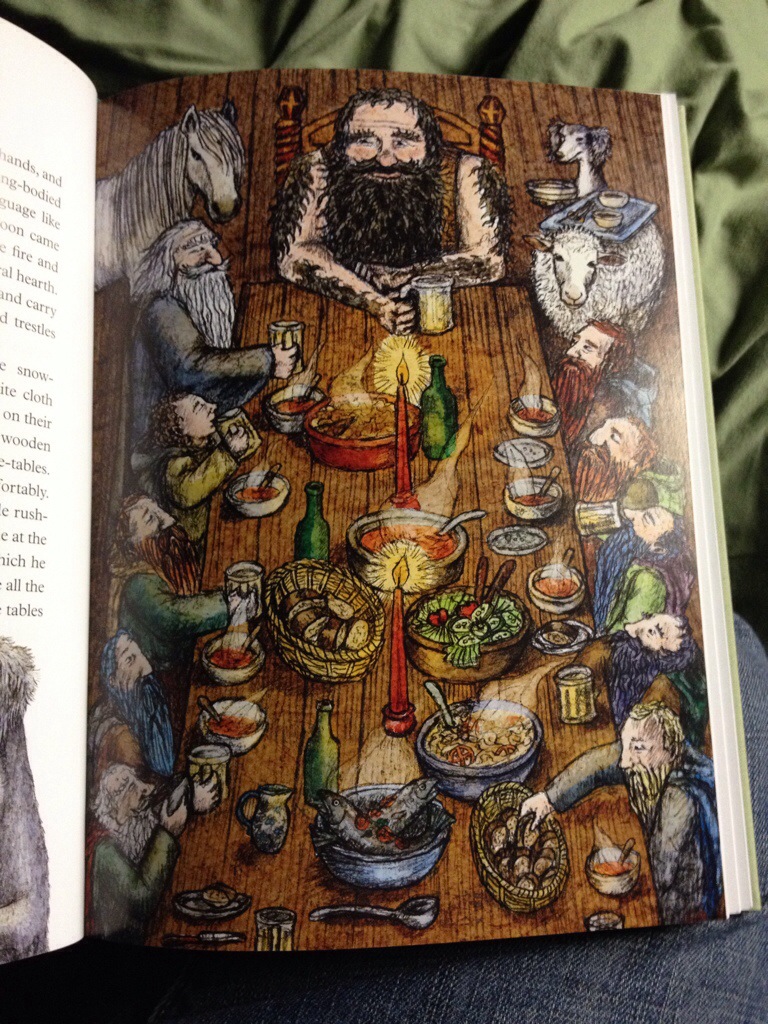
Beorn to be wild.

So soon they were all seated at Beorn’s table, and the hall had not seen such a gathering for many a year.

Then full page illustrations like this are done for big moments in the books like say, meeting a sleeping dragon. I’m not going to spoil that here as it is a nice surprise when you see it.

This isn’t a review of The Hobbit. I mean, the text is exactly the same as it is in any other volume of The Hobbit, except maybe The Annotated Hobbit. Where this volume stand out is the illustrations. If I were a teacher, this would be the volume I’d read to my kids to introduce them to the world of Middle-Earth and fantasy fiction. If I were a parent of a young reader this would be the volume I’d give them for Christmas or their birthday.

The binding is quality material, beautiful yet durable. The illustrations are beautiful yet still approachable for children and the story is of course a brilliant faerie (in the traditional sense of the realm of the fays) tale.

Somes gems from the 1811 Dictionary of the Vulgar Tongue.

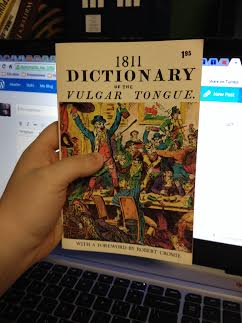
I think it was Neil Gaiman who recommended it on his blog years ago, but I was going through my wishlist on Amazon when I came across this book.

1811dictionaryofthevulguartongueoll

A used copy wasn’t very much. Not the 1.95 that appears on the cover but something like 3 or 4 dollar. I started browsing through early this morning and decided to share some gems with you. Warning, some of them are indeed, as the title says, vulgar but in a strange archaic way. Some of them are still kind of gross.

Apple Dumplin Shop – a woman’s bosom

Banbury story of a cock and a bull – a round about, nonsensical story.

Barrel Fever – he died of barrel fever; he killed himself drinking.

Cackling Farts – Eggs.

Covey – A collection of whores. What a fine covey here is, if the devil would but throw his net!

Death’s head upon a mop stick – A poor miserable, emaciated fellow.

Dicked in the nob – Silly. Crazed.

Eternity Box – Coffin.

To Flash the Hash – To vomit.

Frenchified – Infected with the venereal disease. (Even in the 18th Century France was the butt of jokes.)

Gap Stopper – A whoremaster. (So many of these words are about prostitution in some way. I haven’t even touch the precipice of how many words there are about whores.

Hobberdehoy – Half a man and a half a boy; a lad between both.

Jerrycummumble – To shake, towzle, or tumble about.

Indorser – A sodomite.

King’s Pictures – Coin, money.

Laced Mutton – A prostitute. (That one is especially vulgar.)

Line of the Old Author – A dram of brandy.

Member Mug – A chamber pot.

Nimgimmer – A physician or surgeon, particularly those who cured venereal disease.

Occupy – To occupy a woman; to have carnal knowledge of her.

I think that’s enough. Going through this now I am getting a theme of 18th century England slang. It involved a lot of words for having sex, prostitutes, brothels and venereal disease. I mean what I posted here was just me going in alphabetical order randomly picking words by placing my finger on the page, and I still got words along the sex with prostitutes and spread of diseases theme.  Maybe P – Z is just filled with words about how happy they are in 18th Century England, but I doubt it.

I Actually Miss Thesis.

     Hear me out. I know this is some kind of St. Joseph’s College blasphemy but I actually miss writing thesis. It sounds strange but it was probably the most fulfilling writing I’ve done yet and will be until the novel I am writing is actually done. Everything about it was stressful but the healthy kind of stress. I woke up every day with a purpose, a goal, a deadline and work in a subject I actually enjoyed. If that is what having a deadline on a novel feels like then I am ready to have a deadline.

     I am not just talking about the writing part either. I mean all of it. I miss cataloging all research on index cards, then dividing them into piles of cited and not cited. I think fondly back at pouring over old books in the library, photocopying their pages and underlining in pencil all the parts I need. I still remember the joy I felt when I discovered Evernote’s document camera, where I could photograph whole documents instead of spending all my change photocopying them. Once that happened it was only one update in the app. store later that all the highlighting tools of Evernote’s other app, Stitch, was now implemented into Evernote just when I was running out of documents to cite.

     I don’t know if I’ll ever dive as deep into any piece of literature as I did with Macbeth but thinking about it now I sure would like to. I am not a fool, I know this feeling is part nostalgia and part feeling completely and utterly unfulfilled at my lousy part time job. Still, when I saw the thesis topics for 2014 included one for The Lord of the Rings I felt a void in my chest that I wanted to fill.with hours of research, writing and editing. Each day and each week I knew I had a set amount work on it that I need to accomplish. Today I was thinking of thesis and almost said out loud “What if I just start writing one for the hell of it?” I mean, that’s not crazy right? People do that, I know they do. I’ve heard people like Corey Olsen, the Tolkien Professor talk about it.

     I am not a fool. We were given seven months to work on thesis. Novel writing may be like that but editorial work definitely does not have that long of a deadline except maybe feature articles which are meant to be much longer. I don’t know if I would feel the same way with shorter deadlines but it has to be better what I am doing now. What I mean by that is compared to Senior Thesis, which basically was my job for me at the time even, what I am currently doing to make money feels meaningless and ultimately makes me unhappy. I’ll take short and stressful deadlines over that anyday.

Weird Obsessions – My iTunes Library Playcount

     I think I made the transition to .mp3 a lot later than most. Until 2005 I still mostly played and bought my music on CD’s. My stereo, with a 200 CD’s change attached to it, was still a better audio system than my computer with it’s tiny speakers and subwoofer. My absolute favorite CD’s though I had ripped onto my computer in .mp3 form and made copies of for more car so I wouldn’t damage the originals. When I wanted to play them on my computer I would use WinAmp. This memory might not be correct but I remember making a playlist that would sort them in playcount order that would update as I listened to them. I did this every once in awhile because it was difficult listening to songs a certain order on CD.

     Then I received my first iPod, the iPod nano. I would plug it in, install iTunes and take all those .mp3’s that I had played in WinAmp in my new fancy iTunes library and then onto my iPod. Somewhere along the line I dropped my iPod Nano on Campus of Suffolk’s community college where it ceased to work. Yet, I still used iTunes. It was a slow transition but when I bought my iPod Video with my own money is when I officially made the transition to digital.
     My taste in music would change and so would my iTunes library and every time iTunes would update it would revert the brackets you could sort your music by back to their original format. I would then go in and add Playcount back in. Sometimes that’s how I would listen to my music, in playcount order when shuffle would be kind of disappointing (as shuffle often is) and other times I would search for the tracks that had low play counts and give them a change. My computer was old, from 2002 and I didn’t really seek out upgrading that much. With Windows ME then XP on it I would often have to format the hard drive and reinstall everything then start my play count all over again.
     Then inevitably, one day when looking at my sister’s iTunes on her old desktop I noticed a Top 100 Playlist and asked her how she got that. She explained what a Smart Playlist was and that was that. I made Top 100, 200, 300 Songs Playlist, Top 100 Stand-Up Comedy Tracks, Top 10 Radiohead Songs and etc. Still, I had a lousy computer, an unstable one. Finally, in 2011 my friend Dan convinced me to upgrade my computer. So I saved up money received from family members, income tax check and my own paychecks to finally upgrade my computer. Finally, I had a computer that I could keep a stable iTunes Library on where the play count would never reset.
     It was so frustrating though that the play count wouldn’t go up when I listened to a song on my iPod Video and then my iPod Classic. That all changed when I got an iPhone. Now I have Top 300 Songs, Top 100 Stand-Up Comedy Tracks, Top 100 Soundtrack Songs, and the list is endless. All my plays on my phone sync up with my desktop.
     Rationally, I know the amount of plays a song gets doesn’t affect how good of a song it is. If you think about it, the shorter the song the more likely it’ll reach the end before I skip it and thus increase the playcount. Other songs from artists I used to like before 2011 should be at play counts so high that what I currently listen to wouldn’t break the Top 100. Shuffle, not being random at all but just a organized way of playing songs in a different order tends to play certain track more often than others even when I don’t like them as much.
     I do so enjoy though when I lose myself in new music then finding those new artist have broke my Top 300, 200, 100 and entered the top 50, 25 and 10. I’d be lying if I said I didn’t look at the playlist sometimes choosing a song that I currently love that is at say one play less than a song I used to love and playing it twice just so it’ll rise in the ranks.
     One day though, I’ll have a new computer where I’ll have to start over again and most likely all the songs currently with the highest play count will go back to zero, struggling against the music I am then currently listening to.  

Self-Discovery: Productivity to Avoid Productivity

     In the past, who am I kidding? Currently I have problems with procrastination and staying on task. I think the procrastination started the first time I put something off to play video games until the last day then got away with it. The focusing problem started as a child, when I was diagnosed with A.D.D. Instead of putting me on Ritalin my mother chose to eliminate all artificial flavors and colors from my diet. It worked, I stayed on task and was generally less hyperactive.

     I’m not sure if I still suffer from A.D.D. To be honest I for the most part believe I have gotten over it. My focusing problem is more of an issue of discipline, at least I think so. Since late 2011 / early 2012 I’ve been trying different programs, apps and advice to keep on task. I don’t think much of self-help books but the two I would recommend the most are for nerds and creative types. The Nerdist Way by Chris Hardwick gives a great outline for how you can take your ability to absorb information related to whatever nerdy thing your into and turn it into an ability to help you better yourself. This was the best lesson I learned from Hardwick’s book:

…the brain doesn’t just tell you to do things; it also has a nasty habit of telling you what you CAN’T do- whether or not it’s true. As you go through life you gather self-imposed limits here and there until one day you’re unknowingly trapped trapped in a prison of bullshit limitations. But the truth is, it’s a holographic prison manufactured by your mind in a clumsy attempt to protect you from potential pain.

     Basically, your brain is looking for the shortest path to avoiding the pain of failure. This can lead to it convincing you to not try new things, tasks, jobs etc. but you don’t have to listen all the time.
     The other book, The War of Art by Steven Pressfield defined what keeps your from accomplishing your dreams, from sitting down to write, to paint, to do what needs to be done as a force called Resistance.
     “Procrastination is the most common manifestation of Resistance,” says Pressfield. “Because it’s the easiest to rationalize. We don’t tell ourselves, “I’m never going to write my symphony.” Instead we say, ‘I am going to write my symphony; I’m just going to start tomorrow,”
     Now I don’t actually believe there is a force that keeps me from writing but the metaphor helps. It gives a concrete idea to what is keeping you from doing and allows you to resist. I used to carry this book with me everywhere I went. In fact, I think I’ll reread it soon enough. I’m pretty sure there is a .pdf of it if you search google but I didn’t tell you that.
     Two other useful tools I have been using on both my desktop are called Freedom and Anti-Social. Freedom turns off your Internet completely while Anti-Social merely prevents your from going to certain websites though right now the current version doesn’t recognise a lot of the sites I put in, including reddit. Freedom is the better way to go for just $10 and it was recommended to me by author Neil Gaiman himself, on twitter.

     Evernote though, has been my main savior. I use that for everything. I used to keep a word count on it before I discovered Scrivener had it’s own word count goal meter you can set-up. With the webclipper extension on Chrome I can clip research right into Evernote, plus I have checklists of things I need to do everyday, a particular day or just in the year in general. I honestly would not have gotten through my last two years of college nor my senior thesis without it.
     This brings me to a recent self-discovery that has been preventing me from being as productive as I should. Instead of doing what I should I will find myself doing other tasks that are not as important but fill me up with a sense of accomplishment or that I tell myself I must do in order to do what I should. For example, with writing I will tell myself that if my bedroom it must be clean before I can write in order to have a healthy environment in which to do. See, now that’s bullshit. I’m sitting here at my writing desk right now with my bedroom barely in my periphery. I know there’s a bowl and a coffee mug on my other desk and my garbage can is probably full but those are not preventing me from writing. I can’t even see them. That’s not all though, here are some other tasks I’ll trick myself into doing instead of writing.
  1. Backing up my writing on to my external hard drive and flash drive.
  2. Organising the files, i.e. making new folders, renaming files, etc.
  3. Constructing the perfect playlist or finding the perfect music to listen to while I write.
  4. Completely reorganize my bookcases. This one has the most bizarre connection to writing and the most flimsy but I know I’ve done it.
  5. Searching Google for best apps to keep me from being distracted.
  6. Making coffee.
  7. Cutting my fingernails
  8. Refilling all my fountain pens with ink.
     All of these are bullshit excuses and distractions but it doesn’t stop at writing. Some of these can extend to exercise like the music one or making a protein shake instead coffee or searching Google for the best exercise apps.
    This is kind of a blog post to myself to remind me of this behavior and to prevent it from happening in the future. I know it’s not completely preventable but I am going to try. Here’s to self-improvement.

I keep thinking about Spike Jonze "Her."

    The inability to get Spike Jonze’s Her out of my head doesn’t automatically make it a good film but it is a tell for me that will ultimately be my own conclusion of it.

     Basic premise: Man falls in love with artificial intelligence. Old hat for fans of science fictions while seen as bizarre fetishised premise from the general public. I suggest both of these audiences see this film because the one could use a bit of science fiction in their life that isn’t big budget explosions and the other should gain a better understanding of how complicated relationships are.
     Relationships are the fundamental premise behind this two hour story of a man falling in love and beginning a relationship with his computer. Throw that in a pot with a list of philosophical questions. What does it mean to be intelligent? What does it mean to have emotions? Most importantly though, if someone is intelligent and has emotions are they human?
     Let’s talk about Joaquin Phoenix’s character, Theodore Twombly who I have seen criticised for being a sensitive asshole. That isn’t something to detract from the film but to be celebrated. Theodore is a introverted, anti-social, artsy, somewhat feminine and pretentious writer type who is afraid of change even when that change means new successful romantic relationships and success in his career. He fails to communicate his problems effectively and has difficulty addressing his own emotional shortcomings. 
     He is basically the girl’s best friend character trope turned into a real human being. We’ve seen countless times the hero who is funny, romantic, in touch with his feminine side who’s shy and artsy overlooked by the love interest for the stupid jock type in movies before but neither one of those men are real people. By injecting Theodore with negative traits along with those positive ones we get a real human being in the movie. You need a real human with flaws to interact with Samantha, voiced by Scarlett Johansson, the artificial intelligence he falls in love with in order to see the human qualities within her. You know who Theodore reminds me of? Comedians. Comedians have that balance of emotional problems and asshole behavior mixed with charm and artistic integrity. Just listen to the podcast WTF with Marc Maron or You Made It Weird with Pete Holmes if you don’t believe me.
     While not technically human, the development of Johansson’s character Samantha explores transhumanism that can easily be missed. Samantha has emotions, cognitive reasoning, and the ability to learn from experience like a human but what may be confusing for some is that the audience can forget that she isn’t technically human. Yes, she is female and in love with Theodore but because she is an artificial intelligence that means something entirely different for her. She is self-aware from the moment Theodore install hers, choosing her own name because she likes the way it sounds. This was in a mere moment, between when Theodore asked her what her name was and she answered that out of all the names she could find Samantha was the one she chose.
     I read one review complaining about her verbose nature in the film, the pretentious dialog she sometimes has in exploring her emotions. This is the reviewer looking at the man behind the curtain and asking “This isn’t good dialog based on human dialog” but she is not human. Just because she feels and thinks does not equate to she is human and as human beings who know of no other species who can do this that element of science fiction is important for everyone to think about. She does not learn language over time through experience and interacting with others but is self-aware of language from the beginning. She can process the whole of human literature in the time it takes for Theodore to ask her a question, so yeah, her word choice is going to be quite different from his.
      Let’s not forget the fact that verbal communication is her only form of communication, she has no body language, no faces to tell shorthand how she is feeling rather than using words. I’ve been trying to wrap my head around explaining Samantha, human but not human. The question of monogamy is brought up in the film. How strange must that sound to Samantha, the concept of monogamy when she is capable of so much more. When she tells Theodore how many other people she is talking to and how many others she is in love with I believe her afterwards when she tells him that it doesn’t change how much she loves him just as I completely understand when that isn’t good enough for Theodore. I would not be able to deal with it either but her limitations are different than his as an artificial intelligence. She isn’t human and yet she is.
     There aren’t enough science fiction films like this one. Exploring the human condition and how the rapidly changing technology affects that. It’s a down to Earth story, a story exploring what it means to be a human being rather than being a hero or villain. I can’t even think of the last science fiction movie that I thought about this much. The last movie I thought about this much was There Will Be Blood. Some reviews I read asked questions about the addictive nature of technology, the behind the scenes corporation that created these artificial intelligences and what that means for privacy, what does it mean for feminism when a flawed man can just buy a perfect woman, and then of course the rumor mongering of this being a reactionary film to the break-up of the writer and his wife.
     What I took from the movie is questions. Questions of what does it mean to be human, to be in a relationship, to communicate? What is intelligence and what are emotions and how limited is the human brain? These are the kinds of questions good science fiction asks of us, something that doesn’t often make it to American film and television. This movie was a breath of science fiction fresh air.
     If they were to make another movie based on this premise centering around Amy Adams character who essentially goes through a similar situation as Theodore and titled it Him I would see it in a heartbeat.
     Lastly, I cannot praise enough the score of the film done by Arcade Fire and Owen Pallett sell every emotion of the movie. It’s not available to buy but if you can listen to I highly recommend it. Without it the film would lose part of its emotional core.
     

How will A Song of Ice and Fire / Game of Thrones end? (No spoilers)

With two books to go by the self-admitted slow writer and the producers of the HBO show estimating the series to end at eight seasons the end game for A Song of Ice and Fire / Game of Thrones is far off. Still, I know how it will end, at least I know how viewers will perceive it to end. There will be no spoilers beyond conjecture, and no details of the fates of any characters.
The hype machine is still going strong for this series, with George R.R. Martin’s name constantly in the news, making appearances on Conan and casting confirmations as well unofficial filming footage constantly hitting the sites centered around pop culture. The show’s intention with each season is to build upon the overall arcs of each character with some ending as the seasons go on. The books likewise, because of the way they tell stories using third person limited point of view for different characters in each chapter, tell the stories of said characters as part of any overall story Martin is building towards.
Recalling an article from io9 speaking of Game of Thrones scratching that mystery itch that was left in the wake of Lost brings up the disappointment many felt by the end of series over the ending as it left questions unanswered and the overall conclusion deemed disappointing. Martin himself has said his intention is to avoid a Lost-like ending, proclaiming his disappointment and his hope to deliver on the high expectations of his fans. However, he also expects the ending to be bittersweet.
This is just conjecture but just as the story was inspired by the image of the two dying animals in the first episode and the first book, I expect Martin has had the ending in mind from the very beginning with obvious editing needing to be done as the plot changes and characters are added. While I’ve always expected a bittersweet ending given that the story for the majority a tragedy how satisfying will that ending be to it’s viewers and it’s readers? Let’s avoid questions of a production nature like it’s budget, it’s directing, the cinematography, the acting, etc and just explore it from a storytelling perspective.
Game of Thrones and the even more so the books it’s based on is a world full of characters. With this many characters the odds of satisfying every consumer is slim, but that is to be expected. Every character is someone’s favorite character including the antagonists but not every character is slated to have a complete story-arc as some of the secondary ones are doomed to be metaphorical and sometimes literal causalities to the major point of view ones. If we break it down even further using just the main characters we can expect that when they all converge once again as they did in the beginning of the series that some of these characters will come into conflict. As this is in a sense a political tragedy most of the characters fall into a morally gray area rather than one group being good and the other evil. Therefore, each character probably has a fanbase that’ll be disappoint and one that will be satisfied with how it’ll end overall.

How will it end though? I know how will it end in vague details, just going by what I’ve seen and what I’ve read from the source material plus Martin’s expectation of a “bittersweet” ending and his hope to avoid an ending like Lost. Here it is in the vaguest terms possible. Westeros will be left completely changed but stable in the political sense, not all the characters people hate will die and not all the ones people like will live. There will be sacrifices, sometimes that means a character’s life and sometimes that’ll mean a character’s power. 
Questions that have had speculation surrounding them will be answered with obvious answers and ones no one expected. Questions people didn’t know they should be asking will be answered, which in hindsight viewers will believe that should of been obvious. Questions that everyone has been wondering about for ages will never be answered because stories, like life, don’t have to answer all the questions. 
There will be love, sadness, tears, triumph, victory, tragedy, loneliness, isolation, and most likely satisfaction. Before it is over surely there will be fire and blood, you will hear some roar and some will pay their debts, there will be fury by some, sharp blades by others, and winter will most definitely come. 

Inside Coen Brothers’ Inside Lewyn Davis

     I haven’t seen every Coen Brothers film but I’ve seen the big ones: Raising Arizona, Fargo, The Big Lebowski, O Brother, Where Art Thou?, No Country for Old Men, True Grit, and now Inside Lewyn Davis. 

     All you need to know about the film is that Llewyn Davis is a folk singer, one stuck in a cyclical life of living on couches, barely making ends meet. The movie has no plot but one giant theme of failure. Anyone who is hoping to one day turn their creative outlet into something that can sustain them financially will leave this film feeling down, putting themselves in Llewyn’s place as he struggles to just get by.
     Once part of a duo, his partner threw himself off the George Washington Bridge, now he is basically living the life of a tramp endlessly couch surfing between the parents of his former partner and the couple who is beginning to succeed where he can’t. There is no character arc for Llewyn Davis, but that’s the point. The fact that he does not go through any significant changes, not when he finds out Jean is pregnant, not when he finds out Diane never received the abortion, not when he goes to Chicago and not when he passes the town his now 2-year-old kid would reside in. By the end of the film he is left the same, performing at the Gaslight the songs of his former duo opening for a young Bob Dylan who is about to become a star.

     The most heartbreaking line in the entire film is when Llewyn Davis is Bob Grossman hears this beautiful song and simply replies “I don’t see any money here.” While Llewyn’s story is sad in a pathetic kind of way the movie doesn’t paint him as a saint. In fact, he’s kind of a jerk who is unable to connect with people, dismissive, a bit pretentious and a philanderer. You’re left to wonder if his failures are his own fault or do you admire a man who isn’t willing to compromise his music in order to make a living? The act in which he tries to rejoin the merchant marines after being rejected by Bob Grossman and returning to New York is where Llewyn is the most sympathetic in the film. He returns ready to give up, tired from the stress and burden of it all, realizing he’s not going anywhere with his music. He plans to return to being a merchant marine like his father, to just “exist” as he puts it. He visits his father one last time before he plans to head off, playing a song he says his father used to like. Now his father’s only reaction, due to the onset of dementia or alzheimers and in response, summing up Llewn’s music career nicely, he shits himself without registering his son is even there besides some dead eye contact.
          In the end, he can’t even return to being a merchant marine. Llewyn Davis cannot even enact any kind of change in his life away from his own failures. Is Llewyn Davis’ story a tragedy? No but that does not make it any less sad to see. 


The Last Generation Games of Personal Significance to Me.

     The last generation of consoles (Microsoft Xbox 360, Nintendo Wii, Sony Playstation 3) for the most part is over. I have no plans to purchase the new systems until the price drops and their libraries fill up with quality games. That is quality games I cannot buy on Steam during one of their sales for 50 percent less than retail price. This continues to become a smaller number as time goes on. If you do a quick google search you can see that most systems don’t begin to hit their stride until a year after they come out.
     I specifically own a Xbox 360 and a Nintendo Wii covered in dust but this isn’t disparaging in anyway to Playstation 3. A lot of great games came out exclusively for the PS3 and some of the games on this list are also on that system but I never wanted to buy one. The Xbox 360 got me back into gaming that I had shied from in the early years of high school replacing it with a love of music, not realizing I could do both. An ex-girlfriend specifically got me back into gaming when she had me try Dead Rising, Elder Scrolls IV: Oblivion and Gears of War at her house. In 2007 I had only dated one other gamer five years before with all the exes in between either dismissing video games as childish or irritated that it took time away from spending with them. So when the assistant manager at my job was selling a barely used Xbox 360 I took it as an opportunity to buy one so we may share in something we both enjoyed doing. Unfortunately the relationship didn’t last long enough to see that happen but that fall line-up of games for the 360 got me back into gaming at full throttle with the likes of Halo 3, Bioshock, Mass Effect, Call of Duty 4: Modern Warfare, and The Orange Box.
     The number of games I bought for the Xbox 360 matched the amount I had as a kid for Super Nintendo Entertainment System and doubled what I had for Nintendo 64 and Nintendo GameCube combined. These are the five that had the biggest impact on me. Impact is a bit vague as there is not set criteria in how I am judging these games. When I chose these five I’m thinking of the time I spent playing them, the world that the developers built and the stories and characters created and developed within that world. Two of these are a series of games. Be warned, there will be spoilers.

5. Elder Scrolls IV: Oblivion


     I wonder how many people besides me played Fallout 3 before Oblivion? As previously started, I first tried this game on my ex-girlfriend’s Xbox 360 to which I wasted most of the time creating the ugliest character I could and then remember none of what I did when I actually bought the game two years later. I think she was frustrated I wasn’t taking it as seriously as I should. She had hours into her saves on that game and I couldn’t figure out what the big deal was. I would soon have saves with similar amount of hours. To go from the bleak landscape of the post-nuclear apocalypse to the lush lands of Cyrodiil was quite the change, a welcome one. This game was beautiful but insanely difficult for me compared to Fallout 3, mostly because I didn’t know what I was doing. I didn’t even know you were supposed to repair your items until I had almost completed the game. I would end up saving before almost any encounter with an enemy because I was constantly being killed, needing to load my last save and try some other strategy. Most of those strategies involved running away to fight a lesser creature so I could level up. Navigating through the gates of Oblivion was a constant test of my skill and every quest I completed was done with little health left. While a lot of the faces were goofy looking in hindsight I still look back at this game with fond nostalgia.

4. Portal & Portal 2.

     Games have tried before to be funny, mostly the hack kind of funny with jokes you expect a comedian from the 80’s to make in front of a brick wall and then never to be seen again. Where Portal and its sequel succeed in not only being a hilarious video game by video game standards but other standards of comedy. That’s great but this is a video game, what about the actual gameplay? The first person puzzle mechanic using a gun that creates portals takes baby steps from teaching you how to get to the exit then steps it up with teaching you how to use velocity to complete the puzzle. All of this is framed by the science fiction setting of a futuristic research facility in which you are the guinea pig in experiments by the psychopathic A.I. computer that makes quips and insults about your weight. Throw in your badass but silent female protagonist and you have a game that used all of its aspects to its full potential where other games couldn’t even get one correct often sacrificing one for the other.

3. The Mass Effect series.


     I’ll get this out of the way now, I didn’t hate the ending nor did I really love it. I thought it was wrong for them to change the ending due to fan backlash and I was well aware that my choices ultimately would not matter. It was BioWare’s story to tell, not mine. What made Mass Effect so fun was the illusion of choice. There’s only two other games on this list I played more than Mass Effect 2 and they fill the first and second position. I loved my customized Commander Shepard who thanks to EA’s code they give you was able to tweak in the second game to fit the upgrade appearance. I loved the cast of characters (except Ashley due to her speciesism) they gave you and how you gained their friendship by talking to them, each with their own personal quirks, failures and personalities.
     How will the series be looked at in the future? Will it be considering the original Star Wars trilogy of games or just another trilogy that introduced the trend of moral choices in games? What I do know is that the difference choices, however much they mattered to the overall story, were fun enough to keep me playing the game repeatedly, well, almost. While I repeatedly played and beat the first and second the third game felt so final that I have never played it again after beating. I haven’t touched the downloadable content nor have I taking the varying paths possible that I could of. The third game wrapped up all the storylines so thoroughly for me that I do not know if I’ll ever play it again. It was only after writing this that I realized I had lent my copy to one of best friends who had played the series through with me and that almost two years after it came out he still has my copy of it.

2. Red Dead Redemption


     What the Grand Theft Auto series has always lacked since Grand Theft Auto 3 has been any heart to it’s story with characters that you care about. Niko Belic’s arc within Grand Theft Auto 4 came close but was just out of reach. So Rockstar Games is left asking the question of how can they create a realistic world with unrealistic high levels of violence with a well written story with fleshed out characters. There was no other choice but to make a western where protagonist John Marston struggles against the wilderness, the changing world and his past as an outlaw. Along with the story, the setting is perfect for gameplay, you shoot people, you hunt, you ride on horseback, bring in bounties, play card games and if you want, hogtie a woman and put her on the train tracks. All the while through blood and violence you develop a attachment to John Marston’s stoic man-of-few-words personality only to get your heart broken at the end.
     What Red Dead Redemption gets right is themes of westerns that no other Wild West game has gotten right before while keeping the create chaotic violence nature of the Grand Theft Auto series with cowboys and horses instead of mobsters and cars. It has the revenge story, the ranch story, the outlaw story and the marshall story all within one game. When you play this game you have fun but also get told a story worthy of the great Westerns of cinema. When they made this game you can feel Rockstar wasn’t afraid to escape the tropes they were known for, with unexpected quiet moments along with the loud blood rushing moments. It’s a shame this game has never come to PC dooming it to the die with the previous generations of systems.

1. Elder Scrolls V: Skyrim


     Skyrim is not perfect. The quests can become repetitive at times, there was many bugs, and you have to create your own exceptional loot rather than finding unique ones that you found in Oblivion. What kept me coming back to Skyrim and logging in over 200 hours on just my Xbox 360 copy alone was I never had to play the same way twice. I could be a Breton battlemage, wielding a sword in one hand and a fireball in the other completely aligned with the Stormcloaks but secretly head of the Dark Brotherhood. I could be an Orc dual-wielding axes who can turn into a werewolf completely taking out any person who gets in my way. I could be a High Elf mage, earning my way to head of the Mages’ College while fighting the forces of the dragon Alduin. All of this plus there was no set path, once I went one way I didn’t have to stay on that path I could just explore the wide and beautiful world of Skyrim that Bethesda has created. There is something very satisfying in earning the skills in whatever particular abilities your using, hearing that sound effect as you watch the blue bar increase towards your next level.
     I think satisfying is the word that keeps me coming back to the game. Video games are pure escapism mixed with the illusion of achievement and Skyrim satisfies that in me more than most other games. It’s a fantasy world filled with sword and sorcery which I am drawn to with mixes of humor, violence, the hero’s journey, the byronic hero and the grand scale storytelling mixed with this system of achievement that satisfies my brain. It’s so satisfying when you successfully sneak up on someone with a dagger, when you lockpick that chest with only one lockpick left in your inventory, when you get that slow motion scene of the arrow going into the giant finishing off his last bit of health, and when you successfully defeated a draugr deathlord when you’re horrible outmatched simply by using the right dragon shout to delay him in order to heal. Other games have come and gone but Skyrim for me holds the most replay value for a game that I have played so far. Here’s to hoping I won’t be waiting long for Elder Scrolls VI.

Runners up: Street Fighter IV, Alan Wake, Batman: Arkham series and Bioshock. 

This was written with the help of The Video Game Style Guide and Reference Manual by David Thoms, Kyle Orland and Scott Steinberg and the AP Style Handbook 2013