After Zelda, Superheroes Were My Gateway To Fantasy.

After the news of celebrated writer and artist Darwyn Cooke’s passing, I picked my copy of Absolute DC: New Frontier and absorbed Cooke’s love letter to the Silver Age of the DC Universe.

It’s massive scale and the enormous cast of diverse characters combined with the lingering thoughts about Robert Jordan’s The Eye of the World reminded me that after The Legend of Zelda it was superhero comics that opened the gateway for my love for fantasy.

The similarities between the two are surprisingly plentiful. Just to name a few:

  • Garish costumes.
  • Systems of magic.
  • Unusual names and codenames.
  • The use of symbology.
  • Enhanced or enchanted armor, weapons, and items.
  • Prophecy and legends influencing the protagonists.
  • History, mythology, and continuity that dates back before a current story but has a lingering effect.
  • Multi-faceted heroes and villains that walk the moral line.
  • Archetypal heroes and villains that serve as both characters and symbols for their cause.
  • Conflicts on the micro scale within close knits groups,
  • Macro scale conflicts that put universes in jeopardy,
  • and those in-group conflicts affecting the chance of success of resolving those universal threats.
  • War: The consequences of war, the threat of war, and the aftermath of war.
  • Death: Heroes, villains, love interests, and side characters all dying and in some cases, coming back.

Superhero comics do have the advantage of being broad enough in storytelling that it can encompass many genres including fantasy. A majority of DC’s magic users, including Etrigan, John Constantine, Dr. Fate, Swamp Thing, Alan Scott, and oh, I don’t know, Neil Gaiman’s Sandman all either dip their toes or fully submerge themselves into fantasy.

What it comes down to is world building. If you can understand the chaos that is the worlds of Marvel and DC then remembering the houses on Game of Thrones isn’t that difficult. What’s different is that for Marvel and DC the rules are always changing. What most fantasy tends to do is either established the rules early on or establish the rules and break them early on to create conflict. This is because eventually those fantasy stories are going to end. Comic book companies are in the business of keeping their stories running for as long as they sell. Thus their characters have to change overtime but not necessarily evolve.

Plus, most series of fantasy novels are written by one creator while superhero comics is a ever-spinning turnstile of different writers and artists. Their environment, purpose, supporting cast, powers, appearance, and even their history could change from one writer to another. Elements that stem from roots in fantasy could not longer be in fashion. Now, their powers, equipment, cast, or origin may not be science fiction in nature.

This can be frustrating to the reader which could not be more apparent with the recent developments in [spoilers] DC Universe Rebirth and the first issue of Captain America: Steve Rogers. Change is acceptable in a fantasy novel, especially a series with no previous history (real world history that is) but not so with most superhero comics considering their long history dating back to World War II. Even new superheroes have this struggle because by the time you establish a new character in an ongoing over a certain amount of issues any change you make is going to met with resistance from your readers.

That and the price is why I made the jump. I was frustrated by bad writing of characters I loved and the ever increasing price of comics versus the price of books made the switch easy. Fantasy novels have stayed relatively the same price, they have a more complete story, no other bad writer is coming in and fucking up what the good writer has done, there are no editorial mandates to fit within a big event happening in another series, and  the story is self-contained.

Still, I may never hace found fantasy without superhero comics.

What to Read While Waiting for The Winds of Winter.

Supposedly, George R.R. Martin has finally finished the sixth installment of A Song of Ice and Fire titled The Winds of Winter, according to one of the directors from Game of Thrones. Until it comes from the source this is enitrely speculation. Luckily, there are a lot of books out there for you to read while you wait. Fantasy has not sat back waiting around while Martin works on the book in MSDos, continuing to publish books on par with his ambitious series.

Some of these recommendations are simlar to A Song of Ice and Fire, some only share the same Fantas genre, and lastly is a list of those recommended by others but whose qulaity can be corroborated. By the time you finish this list, maybe the real release date will be announced. Maybe even the book will be released by the time you’re done.

The First Law Trilogy by Joe Abercrombie

The Blade Itself

Before They Are Hanged.

The Last Argument of Kings.

First Law World by Joe Abercrombie

Best Served Cold

The Heroes

Red Country*

Kingkiller Chronicles by Patrick Rothfuss

The Name of the Wind

The Wise Man’s Fear

The Slow Regard of Silents Things (An in between novel.)

Gentleman Bastard Sequence by Scott Lynch

The Lies of Locke Lamora

Red Seas Under Red Skies

The Republic of Thieves

The Farseer Trilogy by Robin Hobb

Assassin’s Apprentice

Royal Assassin*

Assassin’s Quest*

Crescent Moon Kingdoms by Saladin Ahmed

The Throne of the Crescent Moon

Sandman Slim by Richard Kadrey

Sandman Slim

Kill the Dead

Aloha from Hell

Devil Said Bang*

Kill City Blues*

The Getaway Gods*

Novels by Neil Gaiman

Good Omens (written with Terry Pratchett

Neverwhere

Stardust

American Gods

Anansi Boys

The Graveyard Book

The Ocean at the End of the Lane

Books by China Miéville (There are others but I can’t recommend them.)

The City & The City

Kraken

Embassytown

The Inheritance Trilogy by N.K. Jemisen

The Hundred Thousand Kingdoms

The Broken Kingdoms

The Kingdom of Gods

Mistborn by Brandon Sanderson (Though I did not like books two and three.)

The Final Empire

The Well of Ascension

The Hero of Ages

Shattered Sea by Joe Abercrombie

Half A King

Half the World

Half A War

J.R.R. Tolkien’s Legendarium

The Hobbit

The Lord of the Rings

The Silmarillion

The Dark Tower by Stepehen King

The Gunslinger

The Drawing of the Three

The Waste Lands

Wizard and Glass (The worst in the series.)

The Wolves of the Calla

The Song of Sussanah

The Dark Tower

Other Books

Elantris by Brandon Sanderson

The City Stained Red by Sam Sykes


Books Recommended by Others / Series I Haven’t Read Yet

The Stormlight Archive by Brandon Sanderson

The Way of Kings

Words of Radiance

The Tawny Man Trilogy by Robin Hobb

Fool’s Errand

The Golden Fool

Fool Fate

The Fitz and the Fool Trilogy

Fool’s Assassin

Fool’s Quest (coming in August 2015)

Assassin’s Fate (forthcoming 2016)

Other Books

A Crown for Cold Silver by Alex Marshall

Uprooted by Naomi Novik

*Haven’t read yet but didn’t want to cause confusion by breaking up the series.


Appreciating A Clash of Kings by George R.R. Martin

Most people, when talking about the A Song of Ice and Fire series by George R.R. Martin, rank A Feast for Crows as the least interesting followed by A Dance with Dragons.

The first time through though. the second book in the series, A Clash of Kings, bored me in every chapter that wasn’t a Tyrion or Davos chapter. It’s not the book’s fault but a fault of my own.

You see, I have this problem when it comes to reading. Every time I try to read a series in succession I grow bored, no, restless during the second book. It becomes hard for me to concentrate and I always end up putting the book down, especially since I’ve figured out this flaw, and picking up a different one. I think it might stem from my A.D.D. (which I was diagnosed for, not just the many people claiming to have it) but I can’t be sure.

Besides A Clash of Kings other victims of this dilemma include the second Mistborn book, The Well of Ascension by Brandon Sanderson, The Restaurant at the End of the Universe by Douglas Adams, The Adventures of Sherlock Holmes by Sir Arthur Conan Doyle, and even The Two Towers by J.R.R. Tolkien. It’s just when Sam and Frodo are climbing down the elven rope that I put it down though unlike the others listed I picked it back up shortly after. Spoilers ahead. 

Continue reading

G. Willow Wilson’s Fantastic Observation on Genre Fiction and Tropes.

“Genre–whether it’s action/adventure, romance, scifi, fantasy, or superheroes–largely differentiates itself from “mainstream literature” by its heavy reliance on tropes. The lone survivor in a post-apocalyptic landscape. The reluctant paladin called to defend his or her homeland. The white knight. The savior-sacrifice, who must pay the ultimate price to keep the darkness at bay. Good genre books and films succeed because the authors or artists have manipulated these tropes in a particularly skillful way, either by subverting them or unpacking them or, occasionally, pointing right at them. Some of the most stunning works of SF/F produced in the past couple of decades–those that have shifted the cultural conversation–have been those that rely the most heavily on tropes, on what we think we know about a certain genre, and which then proceed to show us, almost by slight-of-hand, what we have overlooked. The Walking Dead. Gravity. District 9. The superb Children of Men. What is masterful about each of these is that the creators exhibited no embarrassment whatsoever about their pulpy source material–instead, they dug deep into the ‘how’ and the ‘why’ and the ‘who’ and used tropes we might have considered all played out (the astronaut in trouble, the zombie apocalypse) to illustrate profoundly heartbreaking things about the human condition. That is, perhaps, genre in a nutshell: it is cliche turned on its head.”

Dr. Lepore’s Lament

May 14, 2015 at 03:03PM

via Instapaper http://ift.tt/1K5pc0v

Hobbit sized editions of The Hobbit and The Lord of the Rings.

Yesterday I received in the mail my pocket sized copies of The Hobbit and The Lord of the Rings pictured here:

IMG_1969.JPG
Also here:

IMG_1970.JPG
The outside feels like this faux leather that bends easily like rubber but seems like it could take a lot of abuse.

IMG_1978.JPG
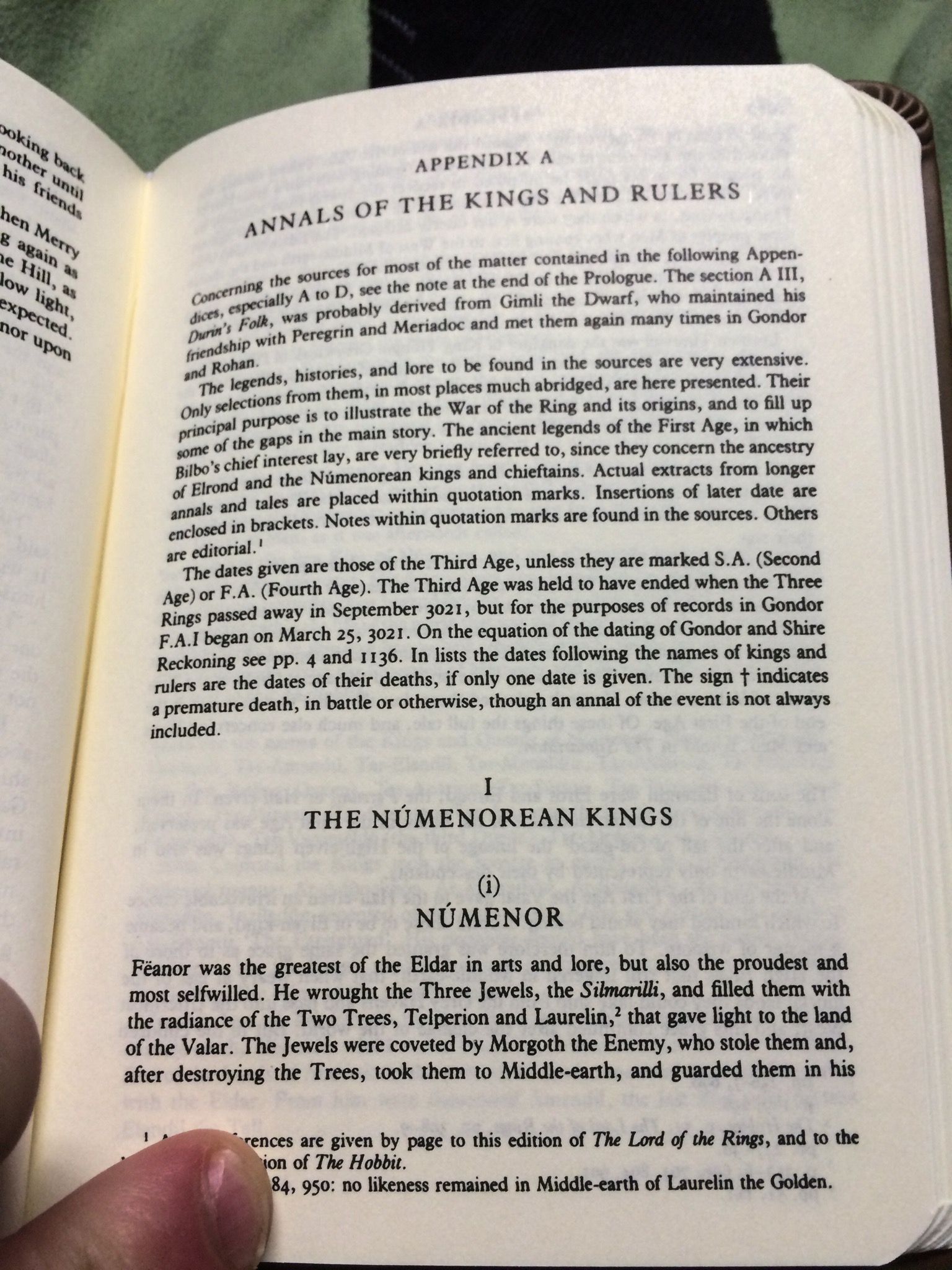
Since they are pocket sized of course the writing is small but the type is equal to any hardcover or paperback edition. In fact, it looks almost exactly the same like they were originally larger and went through a shrink ray.

IMG_1977.JPG

In fact, I was surprised to find The Return of the King still included the appendices and the index.

IMG_1980.JPG

IMG_1982.JPG

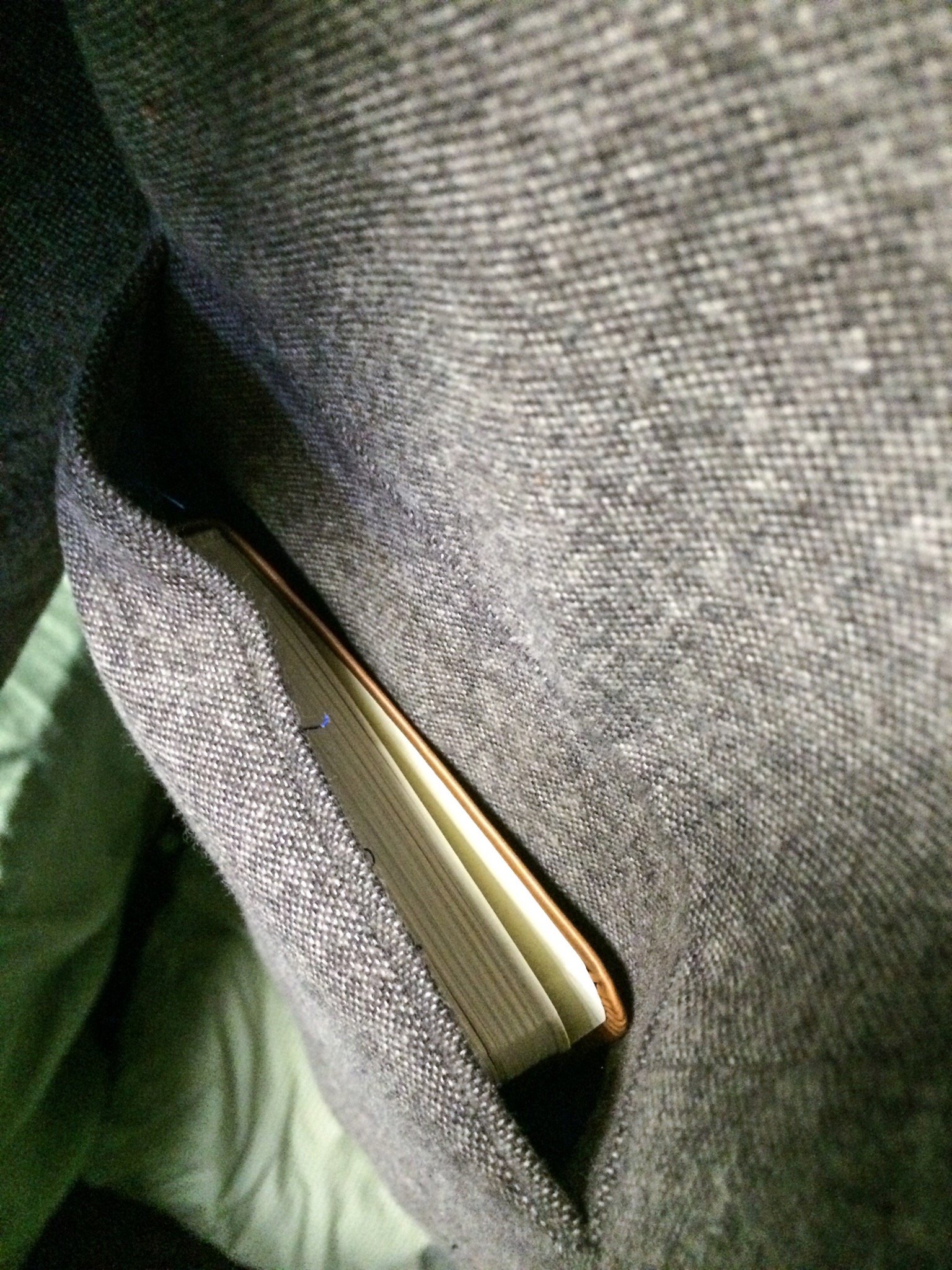
As far as fitting into my pocket is concerned, it fits about as well as an iPhone 6+. They’re definitely not meant for small pockets or tight jeans but fit nicely in the pockets of my coats, sports coats and blazers.

IMG_1975.JPG

IMG_1976.JPG

They’re a nice edition to my collection and I plan on annotating them to death. If you’re buying these books for the first time though I don’t suggest them.

A Word on the Desolation of Smaug – Extended Edition Trailer

http://www.youtube.com/watch?v=wrmCVpAq_s8

The blu-ray for the extended edition of The Hobbit: Desolation of Smaug comes out November 4th in the United States. My copy will hopefully arrive that day but in the meantime here’s a trailer that offer two major bits that got axed from the theatrical edition.

First of all, though he looks a little tall to me in the trailer, that is Thráin, Thorin’s father, confronting Gandalf in Dol Goldur and shouting that Thorin must never enter Erebor. Finally, after getting a name drop in the extended edition of An Unexpected Journey perhaps what has happened to the last dwarven ring of power will be explained. Also, with the jumbling of time Jackson has done I can’t wait to see how he explains Gandalf getting the key and map from Thorin’s father before they’ve actually met in Dol Goldur, that being originally how he got it in the books.

Second, there’s Beorn, barely even in the theatrical release it seem, and this is just my guess, most of what was cut from the film involves Beorn. Before the release of the film there was talks of Beorn hunting down orcs at night to corroborate Thorin and Gandalf’s story. The other part seen in this trailer involving Beorn is in his garden with him chopping wood, possibly for a scene of exposition between Gandalf and Beorn or perhaps the introduction of the dwarves and the telling of what has happened to them so far just as in the books. Also, it looks like a scene in the forest involving Beorn and Gandalf is included as well. It could be possible that Beorn escorts Gandalf part of the way to Dol Goldur considering that the wizard has one of his horses.

Also in the trailer, besides reiterating what was in the theatrical release are scenes involving a conversation between Thorin and Bilbo upon arriving in Laketown and one between the Master of Laketown and Alfred of what Thorin’s quest means to him.

Not included in the trailer but released earlier this summer is extended Mirkwood scene mirroring the one in the book where they have to cross the river and poor Bombur falls into the enchanted water and the company is forced to carry him. You can see most of that scene here:

In interview, Richard Armitage mentions Bilbo and Thorin seeing the white stag, just like in the books, but this stag is projection of Thranduil into the forest. Thorin will try to kill it of course, because dwarf king no like elf king.

It’ll be interesting to see what else was cut that are scenes from the book and what Peter Jackson, Philippa Boyens and Fran Walsh made up for their version of The Hobbit.

Goldman’s The Princess Bride is the best adaptation of Goldman’s The Princess Bride conceivable.

After just finishing reading William Goldman’s The Princess Bride I couldn’t think of anything better to do than to watch the movie that was adapted from it.

The movie, I believe, was better for once. A rare occurrence but one that I will argue my case for.

In my opinion, the movie was better.

In my opinion, the movie was better.

It certainly helps that the screenplay was written by the author of the novel. Most screenplay writers when adapting a book make changes to the story to not streamline the story for time but often change plot points, character motivation and character development that they feel fits better in a film and puts their own twist on the story. Nothing wrong with that mind you, change is part of adaptations. What William Goldman did however was instead take the novel he had written and streamlined it for film without cutting any part of what made the story charming and engaging.

Goldman managed to make a film version of his novel without cutting anything that makes it great.

Goldman managed to make a film version of his novel without cutting anything that makes it great.

Let’s get the negative parts of the adaptation over with that way we don’t have to dwell on it too long.. Out of all the characters the one that suffers most from the change from book to film is Prince Humperdink. His character looms over much of the plot in the book. A  much more intimidating, sociopathic and physically capable figure who poses a major threat to Westley and Buttercup’s romance. His abilities as a great hunter and tracker are explored with greater detail to back up his claim, rather than in the film when the characters just state it as fact. It could be argued that his tracking of Westley and Buttercup in Guilder showcase his hunting skills in the movie but I was never really sold by it too much. 

While Chris Sarandon did a great job as Prince Humperdink he comes off as more of a sniveling schemer who is in fact quite weak compared to the strategic military-like mind of the Prince Humperdink of the book.

What else the reader will get from the book that we don’t get as much in the movie is the backstories of Inigo Montoya and Fezzik. If you love those characters then I highly suggest you read the book. You get both of their upbringings, their trainings and how they end up with Vizzini. Their friendship blossoms in the book as well as Fezzik’s love for rhyming that the film just lightly touches upon.

Speaking of Vizzini, while I would never want to lose Wallace Shawn’s portrayal of the character we don’t get a great understanding that he is fact the planner of the trio. He just comes off sort of silly and dimwitted next to Westley. With the use of backstory we learn that the trio had been successful before in doing mercenary work like this in the past using Inigo’s fencing skills, Fezzik’s strength and Vizzini’s plans. Lastly, and this isn’t the movie or the books fault, but if you’ve seen the movie before you read the book the surprise of the Westley being the Man in Black is ruined for you as it is hard to disguise someone’s look and voice to make that surprise work especially considering when it came out.

Details is what is key. If you like details I highly suggest reading the book because you get better details of every main character and some characters who never get named in the movie. That was what was a shocker for me, that those small characters didn’t get cut from the movie at all. Yellin, the man who has the key to the castle, the Albino who helps Count Rugen torture Westley, Miracle Max’s wife, the lady who boos Princess Buttercup and even Prince Humperdink’s parents who do nothing to move the plot along in the book at all still make appearances in the movie. What else is significant is all the best lines from the book make it into the movie as well. In this day and age book readers usually have to prepare themselves for their favorite line or character to be cut. Not so with The Princess Bride, everything from As You Wish down to To The Pain make it into the movie. Reading the book in a sense was like reading more detailed version of the script while also getting new details about all the best characters.

What was removed from the movie that it benefitted from was two things. First of all, while entertaining, the framework of Goldman translating S. Morgenstern’s much longer version of The Princess Bride into the short version his father read to him as a kid tends to go on too long and interrupt the flow of the story. The part the movie uses involving the grandfather and the grandson in place of Goldman and his father still has the great framework of the story being read to a child without so many interruptions like in the book.

The other part that the movie loses from the book is the horrible ending. Not horrible in the sense it was poorly written or ill conceived but it is so anti-climactic and covered in loose ends that it reduces the rating I gave the book by a whole star on Goodreads, all to sell this weird theme of life isn’t fair. The movie has a much more satisfying ending to both cap off the main characters of Inigo, Fezzik, Buttercup and Westley and ends sweetly with the Grandfather and Grandson. The book’s ending fails on on all fronts.

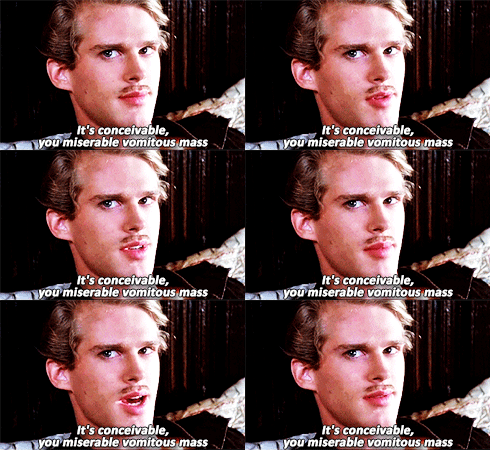
Inconceivable! A movie would actually have a better ending than the book? It's true.

Inconceivable! A movie would actually have a better ending than the book? It’s true.

So do I recommend the book? I certainly do as I am the type of reader who enjoys the little details along with a good plot. Ultimately though I do believe Goldman did a better job of taking his novel and making into a much better screenplay and film.

The Magic of Middle-Earth is Unexplainable, Nor Should It Be.

For this is what your folk would call magic. I believe; though I do not understand clearly what they mean; and they seem also to use the same word of the deceits of the Enemy – Galadriel


“Faerie itself may perhaps most nearly be translated by Magic—but it is magic of a peculiar mood and power, at the furthest pole from the vulgar devices of the laborious, scientific, magician. There is one proviso : if there is any satire present in the tale, one thing must not be made fun of, the magic itself. That must in that story be taken seriously, neither laughed at nor explained away.” – J.R.R. Tolkien, On Fairy Stories.

This video has been gaining traction today detailing how Legolas could not really see as far as he claims according to the laws of physics. This is a common occurrence when it comes to the fantastical things in Tolkien’s Legendarium. The problem is that Tolkien’s magic cannot be explained using a set of rules. It is more mythical and mysterious like the folk tales of Anglo-Saxon, of Norse sagas, Arthurian romance and probably the Old Testament.

I can’t believe I have to explain this but magic isn’t science, it doesn’t have to be explained. It can be, and that can be fun too. Brandon Sanderson is known for his magic systems. He even has what he calls Sanderson’s Laws for his series of rules when creating magic systems. Patrick Rothfuss goes to painstaking details to create rules for his magic system. Then comes naming. Naming cannot be explained like love, humor or music yet no one gives Rothfuss any guff trying to explain the rules of naming.

My point is you can have a magic system in a fantasy book that does not have rules and the work of J.R.R. Tolkien is a prime example. The problem is that “magic” in Middle-Earth is what men and hobbits calls thing they cannot explain leading to reactions like the Galadriel quote above. “Magic” is part of Arda (the earth) itself and the elves are connected permanently to Arda. What we as readers such as men and hobbit may see as magic the elves see as a natural part of their skills and their very being. It is more of a divine power with few explanations to how it really works.

Here is where critics start throwing out words like Deus ex machina without fully understanding what it means. What makes Tolkien’s works have that mythical feeling about them is that there are aspects that cannot be explained such as the elves, the wizards, Balrogs and beings like Sauron.

Partially to blame is Hollywood, Peter Jackson’s The Lord of the Rings trilogy and films in general. Those are visual mediums, as such they need visuals to convey what is going on. The problem is magics is not all visual in any of Tolkien’s books. While the film showed forcefields and battles of light coming from his staff and slashes of his sword versus the Balrogs swipes and cracks of his whip the fight in the books is more of a battle of wills, a battle of power between to divine beings that we cannot see with barely any swordplay.

The Balrog reached the bridge. Gandalf stood in the middle of the span, leaning on the staff in his left hand, but in his other hand Glamdring gleamed, cold and white. His enemy halted again, facing him, and the shadow about it reached out like two vast wings. It raised the whip, and the thongs whined and cracked. Fire came from its nostrils. But Gandalf stood firm.
‘You cannot pass,’ he said. The orcs stood still, and a dead silence fell. ‘I am a servant of the Secret Fire, wielder of the flame of Anor. You cannot pass. The dark fire will not avail you, flame of Udûn. Go back to the Shadow! You cannot pass.’
The Balrog made no answer. The fire in it seemed to die, but the darkness grew. It stepped forward slowly onto the bridge, and suddenly it drew itself up to a great height, and its wings were spread from wall to wall; but still Gandalf could be seen, glimmering in the gloom; he seemed small, and altogether alone: grey and bent, like a wizened tree before the onset of a storm.
From out of the shadow a red sword leaped flaming.
Glamdring glittered white in answer.
There was a ringing clash and a stab of white fire. The Balrog fell back and its sword flew up in molten fragments. The wizard swayed on the bridge, stepped back a pace, and then again stood still.
‘You cannot pass!’ he said.
With a bound the Balrog leaped full upon the bridge. Its whip whirled and hissed.

Neil Gaiman has a great quote about magic in film when talking about the film adaptation of A Winter’s Tale which by the way is a terrible movie mostly despite his warm review of it.

There’s a thing that happens in Hollywood, when you hand in a script with magic in it, and the people at the studio who read it say “We don’t quite understand… can you explain the rules? What are the rules here? The magic must have rules” and sometimes when they say that to me I explain that I am sure it does, just as life has rules, but they didn’t give me a rule book to life when I was born, and I’ve been trying to figure it out as I go along, and I am sure it is the same thing for magic; and sometimes I explain that, yes, the magic has rules, and if they read again carefully they can figure out what they are; and sometimes I sigh and put in a line here and a line there that spells things out, says, YES THESE ARE THE RULES YOU DON’T ACTUALLY HAVE TO PAY ATTENTION and then everyone is very happy. 

I understand, I really do. It seems frustrating because we live in a world of science that strives to explain how the universe works and that can be beautiful but Middle-Earth isn’t our world. It is a epic myth such a The Odyssey, The Prose Edda, The Arthurian Legends and Beowulf. The problem is people still come along and try to explain it or disprove parts of it.

The other problem that pertains to the video about Legolas’s eyes is the perceptions that elves are just some kind of different humanoid type species. Elves are preternatural beings, outside the rules of nature yet also connected to nature itself. This comes from the Tolkien Gateway entry on elves under arts, crafts, powers and magic.

Other races often spoke of ‘Elf magic’, or of objects made by Elves as if they contained enchantments. It is unclear how accurate it is to call Elvish arts and crafts ‘magic’ or ‘enchanted’. Elves themselves only used these words when attempting to simplify or clarify how elvish-made things seemed to have a special quality that no other races were able to achieve. Powerful Elves seemed to have control over nature and the elements, their clothes seemed to shine with their own light, their blades seemed to never lose their sharpness. Less educated folks couldn’t explain these effects, so they simply called them ‘magic’. However, each race had their own special abilities that seemed incomprehensible to others. Hobbits had a seemingly supernatural ability to hide when they wished to remain unseen. Dwarves were unmatched in the art of mining and building halls underground. Wizards had such wisdom and knowledge of the world and all things in it that they appeared to have mystical powers. To each of these races, what they did had nothing to do with magic, it was just how they did things. It may have been so too with Elves. Whether there was any kind of mystical energy involved in the things Elves made can never be proved or disproved.

N.K. Jemisin who wrote the Inheritance trilogy wrote this great article for io9.com just on the subject of magic and rules titled Why does magic need so many rules? In it she makes a connection of what might be the blame for why modern fantasy readers and viewers need rules for magic in Dungeon and Dragons which has rules clearly defined using systems of numbers. Why stop there though? What about video games which also when it comes to magic has a system in place for how magic can be done but Jemisin argues…

It’s supposed to go places science can’t, defy logic, wink at technology, fill us all with the sensawunda that comes of gazing upon a fictional world and seeing something truly different from our own. In most cultures of the world, magic is intimately connected with beliefs regarding life and death – things no one understands, and few expect to. Magic is the motile force of God, or gods. It’s the breath of the earth, the non-meat by-product of existence, that thing that happens when a tree falls in the forest and there’s no one around to hear it. Magic is the mysteries, into which not everyone is so lucky, or unlucky, as to be initiated. It can be affected by belief, the whims of the unseen, harsh language. And it is not…


In LotR, sometimes magic meant forging a ring with a chunk of soul melted into the alloy. Sometimes it meant learning obscure/dead languages, or talking to obscure/dead creatures. Sometimes it meant brandishing a particular kind of stick in a particular kind of way, and shouting really loudly. Sometimes it meant being born with pointy ears, and sometimes resisting magic meant being born with hairy feet. It was organic, embedded, a total crapshoot. And it was wonderful.


The point is, magic can have a system of rules such as Brandon Sanderson’s Mistborn series or Patrick Rothfuss’s Kingkiller Chronicles, hell, my own fiction has a system of magic but quit trying to find fault in Tolkien’s magic system because magic doesn’t always need so many rules.

How will A Song of Ice and Fire / Game of Thrones end? (No spoilers)

With two books to go by the self-admitted slow writer and the producers of the HBO show estimating the series to end at eight seasons the end game for A Song of Ice and Fire / Game of Thrones is far off. Still, I know how it will end, at least I know how viewers will perceive it to end. There will be no spoilers beyond conjecture, and no details of the fates of any characters.
The hype machine is still going strong for this series, with George R.R. Martin’s name constantly in the news, making appearances on Conan and casting confirmations as well unofficial filming footage constantly hitting the sites centered around pop culture. The show’s intention with each season is to build upon the overall arcs of each character with some ending as the seasons go on. The books likewise, because of the way they tell stories using third person limited point of view for different characters in each chapter, tell the stories of said characters as part of any overall story Martin is building towards.
Recalling an article from io9 speaking of Game of Thrones scratching that mystery itch that was left in the wake of Lost brings up the disappointment many felt by the end of series over the ending as it left questions unanswered and the overall conclusion deemed disappointing. Martin himself has said his intention is to avoid a Lost-like ending, proclaiming his disappointment and his hope to deliver on the high expectations of his fans. However, he also expects the ending to be bittersweet.
This is just conjecture but just as the story was inspired by the image of the two dying animals in the first episode and the first book, I expect Martin has had the ending in mind from the very beginning with obvious editing needing to be done as the plot changes and characters are added. While I’ve always expected a bittersweet ending given that the story for the majority a tragedy how satisfying will that ending be to it’s viewers and it’s readers? Let’s avoid questions of a production nature like it’s budget, it’s directing, the cinematography, the acting, etc and just explore it from a storytelling perspective.
Game of Thrones and the even more so the books it’s based on is a world full of characters. With this many characters the odds of satisfying every consumer is slim, but that is to be expected. Every character is someone’s favorite character including the antagonists but not every character is slated to have a complete story-arc as some of the secondary ones are doomed to be metaphorical and sometimes literal causalities to the major point of view ones. If we break it down even further using just the main characters we can expect that when they all converge once again as they did in the beginning of the series that some of these characters will come into conflict. As this is in a sense a political tragedy most of the characters fall into a morally gray area rather than one group being good and the other evil. Therefore, each character probably has a fanbase that’ll be disappoint and one that will be satisfied with how it’ll end overall.

How will it end though? I know how will it end in vague details, just going by what I’ve seen and what I’ve read from the source material plus Martin’s expectation of a “bittersweet” ending and his hope to avoid an ending like Lost. Here it is in the vaguest terms possible. Westeros will be left completely changed but stable in the political sense, not all the characters people hate will die and not all the ones people like will live. There will be sacrifices, sometimes that means a character’s life and sometimes that’ll mean a character’s power. 
Questions that have had speculation surrounding them will be answered with obvious answers and ones no one expected. Questions people didn’t know they should be asking will be answered, which in hindsight viewers will believe that should of been obvious. Questions that everyone has been wondering about for ages will never be answered because stories, like life, don’t have to answer all the questions. 
There will be love, sadness, tears, triumph, victory, tragedy, loneliness, isolation, and most likely satisfaction. Before it is over surely there will be fire and blood, you will hear some roar and some will pay their debts, there will be fury by some, sharp blades by others, and winter will most definitely come.