Late to the Party: Joe Abercrombie’s The Blade Itself.

As far as book go, it isn’t often that I have the forethought or the word on the street to get in on the ground floor of an author or series of novels. Joe Abercrombie is no exception.

I bought the first book in his The First Law trilogy after pre-ordering his new book Half A King. Once I start reading The Blade Itself my first thought was that I have should have read this years ago. Eight years later I’ve finished the first book and I want to read the second book right away. This is highly irregular for me.

I don’t know what it is but I can’t read the second book of a series immediately after reading the first. I get distracted, I get bored, I lose focus, my eyes start to trail off and by the end I can’t remember what really happened. I’m going to be clear: this is a not a slight of the quality of the novels but a flaw that I have. Just look at this list of second books I’ve tried to read immediately after the first and either didn’t enjoy it as much or since discovering this flaw about myself, stopped reading to pick up another time.

  • A Clash of King by George R.R. Martin
  • The Wise Man’s Fear by Patrick Rothfuss
  • Red Seas under Red Skies by Scott Lynch
  • The Well of Ascension by Brandon Sanderson
  • Kill the Dead by Richard Kadrey
  • The Restaurant at the End of the Universe by Douglas Adams

I can recall my experiences with all these books. You know when you read the words but don’t really take in what they’re saying? That happened to me with A Clash of Kings and The Restaurant at the End of the Universes? One, I missed hints to major plot points that would come in future books and the other I was too bored to enjoy Adam’s delightful sense of humor.

I think with The Wise Man’s Fear I got the furthest before putting it down, maybe a hundred pages? This was around the time that I was discovering this flaw about myself and I loved The Name of the Wind so much that I didn’t want the experience of the second book to suffer. With Kill the Dead, the second book in Kadrey’s Sandman Slim series I read the first page, could feel my restlessness settle in and immediately put it down.

Now, Red Seas under Red Skies I remember putting down for maybe a month or two before I had to pick it up again in order to keep up with a friend who was reading, a much faster read than I am. Same thing happened with The Well of Ascension the year before and my opinion of the Mistborn series as a whole suffered for it. That book was torture for me to read through, I found it slow, I found the main character Vin to be a whiny idiot who made the worst decisions and by the end I didn’t care about anything that was happening. I just wanted to finish and when I did I didn’t bother picking up the third book even though my friend had already gotten halfway through it. That was December of 2012 into January 2013 and only now have I even started the third Mistborn book, The Hero of Ages. Guess what? I actually am enjoying despite the sour taste the second book left in my mouth. 

There are of course exceptions. If I read The Lord of the Rings I can read all three front to back with no qualms. Sometimes I’ll just read one only because I have read them so many times and want to read something new but the point is I can read all of them front to back without getting that restless feeling. Same thing happened with most of Stephen King’s The Dark Tower series. It wasn’t until the fourth book that I got restless and even then I only read one book in between before reading book five, six and seven.

The point of all this is that I want to read Before They Are Hanged, the second The First Law book right now. I need to know what happens to the characters now rather than later. I want to know more about the world, about it’s past and what is going to happen next. If an author can get me to do that then the books must be damn good.


What is Tom Bombadil’s significance? The answer from J.R.R. Tolkien himself.

“Tom Bombadil is not an important person – to the narrative. I suppose he has some importance as a ‘comment’. I mean, I do not really write like that: he is just an invention (who first appeared in the Oxford Magazine about 1933), and he represents something that I feel important, though I would not be prepared to analyze the feeling precisely. I would not, however, have left him in, if he did not have some kind of function. I might put it this way. The story is cast in terms of a good side, and a bad side, beauty against ruthless ugliness, tyranny against kingship, moderated freedom with consent against compulsion that has long lost any object save mere power, and so on; but both sides in some degree, conservative or destructive, want a measure of control. but if you have, as it were taken ‘a vow of poverty’, renounced control, and take your delight in things for themselves without reference to yourself, watching, observing, and to some extent knowing, then the question of the rights and wrongs of power and control might become utterly meaningless to you, and the means of power quite valueless. It is a natural pacifist view, which always arises in the mind when there is a war. But the view of Rivendell seems to be that it is an excellent thing to have represented, but that there are in fact things with which it cannot cope; and upon which its existence nonetheless depends. Ultimately only the victory of the West will allow Bombadil to continue, or even to survive. Nothing would be left for him in the world of Sauron.”

– J.R.R. Tolkien from The Letters of J.R.R. Tolkien; Letter #144

Goldman’s The Princess Bride is the best adaptation of Goldman’s The Princess Bride conceivable.

After just finishing reading William Goldman’s The Princess Bride I couldn’t think of anything better to do than to watch the movie that was adapted from it.

The movie, I believe, was better for once. A rare occurrence but one that I will argue my case for.

In my opinion, the movie was better.

In my opinion, the movie was better.

It certainly helps that the screenplay was written by the author of the novel. Most screenplay writers when adapting a book make changes to the story to not streamline the story for time but often change plot points, character motivation and character development that they feel fits better in a film and puts their own twist on the story. Nothing wrong with that mind you, change is part of adaptations. What William Goldman did however was instead take the novel he had written and streamlined it for film without cutting any part of what made the story charming and engaging.

Goldman managed to make a film version of his novel without cutting anything that makes it great.

Goldman managed to make a film version of his novel without cutting anything that makes it great.

Let’s get the negative parts of the adaptation over with that way we don’t have to dwell on it too long.. Out of all the characters the one that suffers most from the change from book to film is Prince Humperdink. His character looms over much of the plot in the book. A  much more intimidating, sociopathic and physically capable figure who poses a major threat to Westley and Buttercup’s romance. His abilities as a great hunter and tracker are explored with greater detail to back up his claim, rather than in the film when the characters just state it as fact. It could be argued that his tracking of Westley and Buttercup in Guilder showcase his hunting skills in the movie but I was never really sold by it too much. 

While Chris Sarandon did a great job as Prince Humperdink he comes off as more of a sniveling schemer who is in fact quite weak compared to the strategic military-like mind of the Prince Humperdink of the book.

What else the reader will get from the book that we don’t get as much in the movie is the backstories of Inigo Montoya and Fezzik. If you love those characters then I highly suggest you read the book. You get both of their upbringings, their trainings and how they end up with Vizzini. Their friendship blossoms in the book as well as Fezzik’s love for rhyming that the film just lightly touches upon.

Speaking of Vizzini, while I would never want to lose Wallace Shawn’s portrayal of the character we don’t get a great understanding that he is fact the planner of the trio. He just comes off sort of silly and dimwitted next to Westley. With the use of backstory we learn that the trio had been successful before in doing mercenary work like this in the past using Inigo’s fencing skills, Fezzik’s strength and Vizzini’s plans. Lastly, and this isn’t the movie or the books fault, but if you’ve seen the movie before you read the book the surprise of the Westley being the Man in Black is ruined for you as it is hard to disguise someone’s look and voice to make that surprise work especially considering when it came out.

Details is what is key. If you like details I highly suggest reading the book because you get better details of every main character and some characters who never get named in the movie. That was what was a shocker for me, that those small characters didn’t get cut from the movie at all. Yellin, the man who has the key to the castle, the Albino who helps Count Rugen torture Westley, Miracle Max’s wife, the lady who boos Princess Buttercup and even Prince Humperdink’s parents who do nothing to move the plot along in the book at all still make appearances in the movie. What else is significant is all the best lines from the book make it into the movie as well. In this day and age book readers usually have to prepare themselves for their favorite line or character to be cut. Not so with The Princess Bride, everything from As You Wish down to To The Pain make it into the movie. Reading the book in a sense was like reading more detailed version of the script while also getting new details about all the best characters.

What was removed from the movie that it benefitted from was two things. First of all, while entertaining, the framework of Goldman translating S. Morgenstern’s much longer version of The Princess Bride into the short version his father read to him as a kid tends to go on too long and interrupt the flow of the story. The part the movie uses involving the grandfather and the grandson in place of Goldman and his father still has the great framework of the story being read to a child without so many interruptions like in the book.

The other part that the movie loses from the book is the horrible ending. Not horrible in the sense it was poorly written or ill conceived but it is so anti-climactic and covered in loose ends that it reduces the rating I gave the book by a whole star on Goodreads, all to sell this weird theme of life isn’t fair. The movie has a much more satisfying ending to both cap off the main characters of Inigo, Fezzik, Buttercup and Westley and ends sweetly with the Grandfather and Grandson. The book’s ending fails on on all fronts.

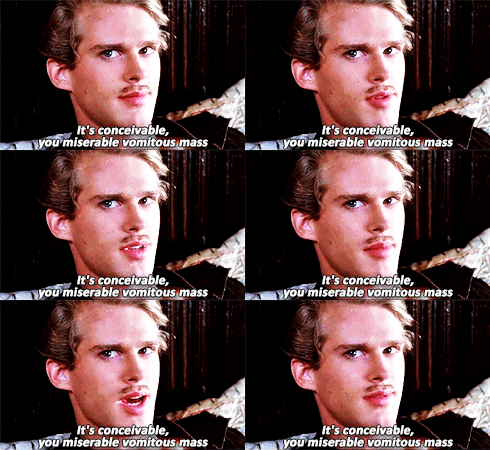
Inconceivable! A movie would actually have a better ending than the book? It's true.

Inconceivable! A movie would actually have a better ending than the book? It’s true.

So do I recommend the book? I certainly do as I am the type of reader who enjoys the little details along with a good plot. Ultimately though I do believe Goldman did a better job of taking his novel and making into a much better screenplay and film.

I Just Want To Keep Typing with My Mechanical Keyboard.

Thanks to the encouragement from a programer/writer friend I bought a mechanical keyboard. Specifically a Das Keyboard Model S Professional Click Pressure Point Mechanical Keyboard which I would recommend to anyone. It’s expensive, and you might be thinking that a keyboard isn’t worth that much. I thought the same thing, it is an extravagant purchase but one I didn’t buy lightly.

Most of the time I write on my laptop, that’s the productivity machine while my desktop, which I’m writing this blogpost on I call my distraction machine. It has all my Steam games, my images, my photos, my music, my videos, and everything that isn’t writing. With my laptop I don’t have anything but writing and maybe some wallpaper on it. The only other files on it are for research for my writing, Nothing to distract me.

This keyboard though, it makes me want to write more on my desktop. I mean, it makes sense. A full keyboard, a large monitor, it seems like it would be perfect for writing. So I figured I would try to write on here and learn to ignore the distractions. I may not always be able to keep it separate so I might as well train myself to not be distracted.

It has proven difficult thanks to the Summer Steam Sale that happened about two weeks ago. I bought Borderlands 2 which I avoided buying on Xbox 360 thanks to both Skyrim occupying my attention for three years and reapplying for college around the time that it came out.

So what is a mechanical keyboard? Well, I don’t know about everyone else who reads this or how new the modern non-mechanical keyboards are but most of them don’t have that clickity clack noise you get from old keyboards during the 1980s and 1990s. From what I gathered, in the 90s keyboard manufacturers started using rubber dome switches. That is what connect the key you press to the circuitry that produces the letter you are pressing. This was cheaper than mechanical keys due to easier production. Cheaper products mean more sales and more profit.

Oh man though, it just does not feel the same. Instead that rubber membrane to connect the key to the circuitry that sends what you’ve pressed to your computer mechanical keyboards use physical switches. in order to produce the key you want you have to fully press the key. This leads to that audible sound you remember from old movies or from when you were younger depending on your age. I’ve read that it also makes your typing more accurate but I am not sure about that yet. It’s only been about a week.

I will say I can type much faster with this. I don’t know if it’s just because I like the feel of a mechanical keyboard, a memory sense from the computers I had when I was younger or if it’s just something that comes along with using a mechanical keyboard.

All I know is that typing on it is much more satisfying than any other keyboard I’ve used or the one on my laptop. I actively want to write more because of this keyboard. Hell, I only wrote this blog post so I could use the keyboard more. I fully support your decision to treat yourself to a mechanical keyboard, though I am not responsible for your financial mismanagement.

The Magic of Middle-Earth is Unexplainable, Nor Should It Be.

For this is what your folk would call magic. I believe; though I do not understand clearly what they mean; and they seem also to use the same word of the deceits of the Enemy – Galadriel


“Faerie itself may perhaps most nearly be translated by Magic—but it is magic of a peculiar mood and power, at the furthest pole from the vulgar devices of the laborious, scientific, magician. There is one proviso : if there is any satire present in the tale, one thing must not be made fun of, the magic itself. That must in that story be taken seriously, neither laughed at nor explained away.” – J.R.R. Tolkien, On Fairy Stories.

This video has been gaining traction today detailing how Legolas could not really see as far as he claims according to the laws of physics. This is a common occurrence when it comes to the fantastical things in Tolkien’s Legendarium. The problem is that Tolkien’s magic cannot be explained using a set of rules. It is more mythical and mysterious like the folk tales of Anglo-Saxon, of Norse sagas, Arthurian romance and probably the Old Testament.

I can’t believe I have to explain this but magic isn’t science, it doesn’t have to be explained. It can be, and that can be fun too. Brandon Sanderson is known for his magic systems. He even has what he calls Sanderson’s Laws for his series of rules when creating magic systems. Patrick Rothfuss goes to painstaking details to create rules for his magic system. Then comes naming. Naming cannot be explained like love, humor or music yet no one gives Rothfuss any guff trying to explain the rules of naming.

My point is you can have a magic system in a fantasy book that does not have rules and the work of J.R.R. Tolkien is a prime example. The problem is that “magic” in Middle-Earth is what men and hobbits calls thing they cannot explain leading to reactions like the Galadriel quote above. “Magic” is part of Arda (the earth) itself and the elves are connected permanently to Arda. What we as readers such as men and hobbit may see as magic the elves see as a natural part of their skills and their very being. It is more of a divine power with few explanations to how it really works.

Here is where critics start throwing out words like Deus ex machina without fully understanding what it means. What makes Tolkien’s works have that mythical feeling about them is that there are aspects that cannot be explained such as the elves, the wizards, Balrogs and beings like Sauron.

Partially to blame is Hollywood, Peter Jackson’s The Lord of the Rings trilogy and films in general. Those are visual mediums, as such they need visuals to convey what is going on. The problem is magics is not all visual in any of Tolkien’s books. While the film showed forcefields and battles of light coming from his staff and slashes of his sword versus the Balrogs swipes and cracks of his whip the fight in the books is more of a battle of wills, a battle of power between to divine beings that we cannot see with barely any swordplay.

The Balrog reached the bridge. Gandalf stood in the middle of the span, leaning on the staff in his left hand, but in his other hand Glamdring gleamed, cold and white. His enemy halted again, facing him, and the shadow about it reached out like two vast wings. It raised the whip, and the thongs whined and cracked. Fire came from its nostrils. But Gandalf stood firm.
‘You cannot pass,’ he said. The orcs stood still, and a dead silence fell. ‘I am a servant of the Secret Fire, wielder of the flame of Anor. You cannot pass. The dark fire will not avail you, flame of Udûn. Go back to the Shadow! You cannot pass.’
The Balrog made no answer. The fire in it seemed to die, but the darkness grew. It stepped forward slowly onto the bridge, and suddenly it drew itself up to a great height, and its wings were spread from wall to wall; but still Gandalf could be seen, glimmering in the gloom; he seemed small, and altogether alone: grey and bent, like a wizened tree before the onset of a storm.
From out of the shadow a red sword leaped flaming.
Glamdring glittered white in answer.
There was a ringing clash and a stab of white fire. The Balrog fell back and its sword flew up in molten fragments. The wizard swayed on the bridge, stepped back a pace, and then again stood still.
‘You cannot pass!’ he said.
With a bound the Balrog leaped full upon the bridge. Its whip whirled and hissed.

Neil Gaiman has a great quote about magic in film when talking about the film adaptation of A Winter’s Tale which by the way is a terrible movie mostly despite his warm review of it.

There’s a thing that happens in Hollywood, when you hand in a script with magic in it, and the people at the studio who read it say “We don’t quite understand… can you explain the rules? What are the rules here? The magic must have rules” and sometimes when they say that to me I explain that I am sure it does, just as life has rules, but they didn’t give me a rule book to life when I was born, and I’ve been trying to figure it out as I go along, and I am sure it is the same thing for magic; and sometimes I explain that, yes, the magic has rules, and if they read again carefully they can figure out what they are; and sometimes I sigh and put in a line here and a line there that spells things out, says, YES THESE ARE THE RULES YOU DON’T ACTUALLY HAVE TO PAY ATTENTION and then everyone is very happy. 

I understand, I really do. It seems frustrating because we live in a world of science that strives to explain how the universe works and that can be beautiful but Middle-Earth isn’t our world. It is a epic myth such a The Odyssey, The Prose Edda, The Arthurian Legends and Beowulf. The problem is people still come along and try to explain it or disprove parts of it.

The other problem that pertains to the video about Legolas’s eyes is the perceptions that elves are just some kind of different humanoid type species. Elves are preternatural beings, outside the rules of nature yet also connected to nature itself. This comes from the Tolkien Gateway entry on elves under arts, crafts, powers and magic.

Other races often spoke of ‘Elf magic’, or of objects made by Elves as if they contained enchantments. It is unclear how accurate it is to call Elvish arts and crafts ‘magic’ or ‘enchanted’. Elves themselves only used these words when attempting to simplify or clarify how elvish-made things seemed to have a special quality that no other races were able to achieve. Powerful Elves seemed to have control over nature and the elements, their clothes seemed to shine with their own light, their blades seemed to never lose their sharpness. Less educated folks couldn’t explain these effects, so they simply called them ‘magic’. However, each race had their own special abilities that seemed incomprehensible to others. Hobbits had a seemingly supernatural ability to hide when they wished to remain unseen. Dwarves were unmatched in the art of mining and building halls underground. Wizards had such wisdom and knowledge of the world and all things in it that they appeared to have mystical powers. To each of these races, what they did had nothing to do with magic, it was just how they did things. It may have been so too with Elves. Whether there was any kind of mystical energy involved in the things Elves made can never be proved or disproved.

N.K. Jemisin who wrote the Inheritance trilogy wrote this great article for io9.com just on the subject of magic and rules titled Why does magic need so many rules? In it she makes a connection of what might be the blame for why modern fantasy readers and viewers need rules for magic in Dungeon and Dragons which has rules clearly defined using systems of numbers. Why stop there though? What about video games which also when it comes to magic has a system in place for how magic can be done but Jemisin argues…

It’s supposed to go places science can’t, defy logic, wink at technology, fill us all with the sensawunda that comes of gazing upon a fictional world and seeing something truly different from our own. In most cultures of the world, magic is intimately connected with beliefs regarding life and death – things no one understands, and few expect to. Magic is the motile force of God, or gods. It’s the breath of the earth, the non-meat by-product of existence, that thing that happens when a tree falls in the forest and there’s no one around to hear it. Magic is the mysteries, into which not everyone is so lucky, or unlucky, as to be initiated. It can be affected by belief, the whims of the unseen, harsh language. And it is not…


In LotR, sometimes magic meant forging a ring with a chunk of soul melted into the alloy. Sometimes it meant learning obscure/dead languages, or talking to obscure/dead creatures. Sometimes it meant brandishing a particular kind of stick in a particular kind of way, and shouting really loudly. Sometimes it meant being born with pointy ears, and sometimes resisting magic meant being born with hairy feet. It was organic, embedded, a total crapshoot. And it was wonderful.


The point is, magic can have a system of rules such as Brandon Sanderson’s Mistborn series or Patrick Rothfuss’s Kingkiller Chronicles, hell, my own fiction has a system of magic but quit trying to find fault in Tolkien’s magic system because magic doesn’t always need so many rules.

Impressive worldbuilding from Saladin Ahmed’s Throne of the Crescent Moon

Throne of the Crescent Moon by Saladin Ahmed.

Throne of the Crescent Moon by Saladin Ahmed.

Here’s a book recommended to me by Keri, a longtime fellow book buyer who also recommended to me three of my favorite modern day fantasy books that I just read this past week. I honestly didn’t know what to expect from Throne of the Crescent Moon by Saladin Ahmed.

As someone whose main interest is medievalism and fantasy I’m so used to that being the background for worldbuilding in epic fantasy books. So when I read this I was surprised to find it based on Arab and Middle Eastern culture which now seems so obvious as a rich source for worldbuilding that I am surprised it isn’t done more. Maybe it has and I’ve just not yet discovered those books.

The worldbuilding is where this book shines. The magic system is diverse, from the brief glimpse we get of it requires both vocal and written incantations. The types of monsters called ghuls which are raised from different elements including sand, water and skin ghuls. What stands out the most is the main city of Dhamsawaat brought to life by block names, class of people, merchants, factions and of course the royal palace of the Khalif which contains the titled Throne of the Crescent Moon.

The main characters, Doctor Adoulla Makhslood, Raseed bas Raseed, Zamia, Dawoud and Litaz all get points of views which really brings them to life as we get the inner workings of their struggle switching without delaying the action. Each one has both an inner and outer struggle you get to know and understand while also developing the relationships between the characters by letting us know what they think of one another. I think of George R.R. Martin’s A Song of Ice and Fire with each point-of-view chapter having a cap off at the end of each chapter. What Ahmed does is switches point of view from one chapter to the next in the middle of action. Just as an example Adoulla could be fighting a ghul with Raseed and be cornered and outnumbered then immediately the next chapter we get Raseed’s point of view as he tries to save his mentor.

The themes that come out in the book that I thoroughly enjoyed because of the switching point of views is the dynamics of age and youth, piety and apathy, experience and naievity. Adoulla, Dawoud and Litaz are much older having had their adventures together for many years. Their reaction to society is less rigid, more open minded as they’ve seen much of the world. Adoulla is very much a cynical old man wishing to retire viewing the established ruling power as incompetent if not corrupt. Zamia and Raseed both have a very rigid view of the world with very little experience of other cultures and ideas. Raseed because of the religious order and Zamia because of her tribe follow a strict set of rules that has been taught to them without questioning if those rules may be wrong or right in a given situation.

Where the novel is weak is in it’s plot development. The middle section after the setup of the conflict takes so long to gather the allies, uncover the secrets of their enemy and develop the plan only for the climax to be over in a blink of an eye. It never gets slow, only because by the time you’ve read the middle section you’re enthralled by the characters. You want to know more about them even when the plot isn’t advancing. The other weak part is the villain himself who we learn almost nothing about except for his name. Then when we finally meet him he barely speaks and is defeated in the blink of an eye after one of the characters finds his inner strength to overcome his self-doubt caused by the villain’s magic. His second in command does all the dirty work and gets the most development through exposition.

Does that seem harsh? I’m not sure but I would still recommend this book despite the little bit of shortcomings. I’m looking forward to the second novel The Thousand and One and how he’ll bring his main cast of characters back together.

I keep thinking about Spike Jonze "Her."

    The inability to get Spike Jonze’s Her out of my head doesn’t automatically make it a good film but it is a tell for me that will ultimately be my own conclusion of it.

     Basic premise: Man falls in love with artificial intelligence. Old hat for fans of science fictions while seen as bizarre fetishised premise from the general public. I suggest both of these audiences see this film because the one could use a bit of science fiction in their life that isn’t big budget explosions and the other should gain a better understanding of how complicated relationships are.
     Relationships are the fundamental premise behind this two hour story of a man falling in love and beginning a relationship with his computer. Throw that in a pot with a list of philosophical questions. What does it mean to be intelligent? What does it mean to have emotions? Most importantly though, if someone is intelligent and has emotions are they human?
     Let’s talk about Joaquin Phoenix’s character, Theodore Twombly who I have seen criticised for being a sensitive asshole. That isn’t something to detract from the film but to be celebrated. Theodore is a introverted, anti-social, artsy, somewhat feminine and pretentious writer type who is afraid of change even when that change means new successful romantic relationships and success in his career. He fails to communicate his problems effectively and has difficulty addressing his own emotional shortcomings. 
     He is basically the girl’s best friend character trope turned into a real human being. We’ve seen countless times the hero who is funny, romantic, in touch with his feminine side who’s shy and artsy overlooked by the love interest for the stupid jock type in movies before but neither one of those men are real people. By injecting Theodore with negative traits along with those positive ones we get a real human being in the movie. You need a real human with flaws to interact with Samantha, voiced by Scarlett Johansson, the artificial intelligence he falls in love with in order to see the human qualities within her. You know who Theodore reminds me of? Comedians. Comedians have that balance of emotional problems and asshole behavior mixed with charm and artistic integrity. Just listen to the podcast WTF with Marc Maron or You Made It Weird with Pete Holmes if you don’t believe me.
     While not technically human, the development of Johansson’s character Samantha explores transhumanism that can easily be missed. Samantha has emotions, cognitive reasoning, and the ability to learn from experience like a human but what may be confusing for some is that the audience can forget that she isn’t technically human. Yes, she is female and in love with Theodore but because she is an artificial intelligence that means something entirely different for her. She is self-aware from the moment Theodore install hers, choosing her own name because she likes the way it sounds. This was in a mere moment, between when Theodore asked her what her name was and she answered that out of all the names she could find Samantha was the one she chose.
     I read one review complaining about her verbose nature in the film, the pretentious dialog she sometimes has in exploring her emotions. This is the reviewer looking at the man behind the curtain and asking “This isn’t good dialog based on human dialog” but she is not human. Just because she feels and thinks does not equate to she is human and as human beings who know of no other species who can do this that element of science fiction is important for everyone to think about. She does not learn language over time through experience and interacting with others but is self-aware of language from the beginning. She can process the whole of human literature in the time it takes for Theodore to ask her a question, so yeah, her word choice is going to be quite different from his.
      Let’s not forget the fact that verbal communication is her only form of communication, she has no body language, no faces to tell shorthand how she is feeling rather than using words. I’ve been trying to wrap my head around explaining Samantha, human but not human. The question of monogamy is brought up in the film. How strange must that sound to Samantha, the concept of monogamy when she is capable of so much more. When she tells Theodore how many other people she is talking to and how many others she is in love with I believe her afterwards when she tells him that it doesn’t change how much she loves him just as I completely understand when that isn’t good enough for Theodore. I would not be able to deal with it either but her limitations are different than his as an artificial intelligence. She isn’t human and yet she is.
     There aren’t enough science fiction films like this one. Exploring the human condition and how the rapidly changing technology affects that. It’s a down to Earth story, a story exploring what it means to be a human being rather than being a hero or villain. I can’t even think of the last science fiction movie that I thought about this much. The last movie I thought about this much was There Will Be Blood. Some reviews I read asked questions about the addictive nature of technology, the behind the scenes corporation that created these artificial intelligences and what that means for privacy, what does it mean for feminism when a flawed man can just buy a perfect woman, and then of course the rumor mongering of this being a reactionary film to the break-up of the writer and his wife.
     What I took from the movie is questions. Questions of what does it mean to be human, to be in a relationship, to communicate? What is intelligence and what are emotions and how limited is the human brain? These are the kinds of questions good science fiction asks of us, something that doesn’t often make it to American film and television. This movie was a breath of science fiction fresh air.
     If they were to make another movie based on this premise centering around Amy Adams character who essentially goes through a similar situation as Theodore and titled it Him I would see it in a heartbeat.
     Lastly, I cannot praise enough the score of the film done by Arcade Fire and Owen Pallett sell every emotion of the movie. It’s not available to buy but if you can listen to I highly recommend it. Without it the film would lose part of its emotional core.
     

Inside Coen Brothers’ Inside Lewyn Davis

     I haven’t seen every Coen Brothers film but I’ve seen the big ones: Raising Arizona, Fargo, The Big Lebowski, O Brother, Where Art Thou?, No Country for Old Men, True Grit, and now Inside Lewyn Davis. 

     All you need to know about the film is that Llewyn Davis is a folk singer, one stuck in a cyclical life of living on couches, barely making ends meet. The movie has no plot but one giant theme of failure. Anyone who is hoping to one day turn their creative outlet into something that can sustain them financially will leave this film feeling down, putting themselves in Llewyn’s place as he struggles to just get by.
     Once part of a duo, his partner threw himself off the George Washington Bridge, now he is basically living the life of a tramp endlessly couch surfing between the parents of his former partner and the couple who is beginning to succeed where he can’t. There is no character arc for Llewyn Davis, but that’s the point. The fact that he does not go through any significant changes, not when he finds out Jean is pregnant, not when he finds out Diane never received the abortion, not when he goes to Chicago and not when he passes the town his now 2-year-old kid would reside in. By the end of the film he is left the same, performing at the Gaslight the songs of his former duo opening for a young Bob Dylan who is about to become a star.

     The most heartbreaking line in the entire film is when Llewyn Davis is Bob Grossman hears this beautiful song and simply replies “I don’t see any money here.” While Llewyn’s story is sad in a pathetic kind of way the movie doesn’t paint him as a saint. In fact, he’s kind of a jerk who is unable to connect with people, dismissive, a bit pretentious and a philanderer. You’re left to wonder if his failures are his own fault or do you admire a man who isn’t willing to compromise his music in order to make a living? The act in which he tries to rejoin the merchant marines after being rejected by Bob Grossman and returning to New York is where Llewyn is the most sympathetic in the film. He returns ready to give up, tired from the stress and burden of it all, realizing he’s not going anywhere with his music. He plans to return to being a merchant marine like his father, to just “exist” as he puts it. He visits his father one last time before he plans to head off, playing a song he says his father used to like. Now his father’s only reaction, due to the onset of dementia or alzheimers and in response, summing up Llewn’s music career nicely, he shits himself without registering his son is even there besides some dead eye contact.
          In the end, he can’t even return to being a merchant marine. Llewyn Davis cannot even enact any kind of change in his life away from his own failures. Is Llewyn Davis’ story a tragedy? No but that does not make it any less sad to see. 


Dear 2014: Make me care about movies again.

     BREAKING – A 28-year-old man in Lake Ronkonkoma finds films in 2013 unmemorable, says local 28-year-old man.

     Right now, Groundhog Day (1993) is playing next to me and it reminded me of all of these best of lists sites compose before the new year and my list of films fall short. Besides The Hobbit: The Desolation of Smaug, I cannot think of movie from 2013 that I either want to see or want to rewatch. I love movies, I really do. I minored in film, more on the writing side than the producing kind and so my hope for 2014 is that there will be films that make me care again.

     Maybe the issue is me. I mean people change, yes? Here’s a list of movies from last year I thought I would care about, that I’d be dying to see. In fact, a lot of these movies I am pretty sure I saw the trailers for in 2012 or early 2013 and thought hey, I should go see that.
  • Anchorman 2: The Legend Continues
  • Elysium
  • Man of Steel
  • Kick-Ass 2
  • The Great Gatsby
  • The Wolverine (maybe…)
  • Iron Man 3
  • World War Z
  • Oldboy

     Most of the movies I did see, like Thor: The Dark World, Star Trek Into Darkness and Ender’s Game I have no desire to see again. Those that were highly praised like Gravity, American Hustle, Wolf of Wall Street, and 12 Years A Slave for some reason I have no desire to see. I know these movies are probably good, worthy of their praise but when I think of going to see them the words not worth it spring to mine.

     The biggest disappointment though was Edgar Wright’s The World’s End I had so much hope for this movie, as Hot Fuzz is up there with one of my most watched and favorite movies of all time. So when Edgar Wright promises this film was Shaun of the Dead x Hot Fuzz I had high hopes for what I thought would be another British comedy exploring science fiction survival genre the way the other explored the zombie and buddy cop genre. The movie starts off slow, with Simon Pegg’s narration from his unlikeable character. Shaun was a loser that made us laugh. Gary King is a loser who never moved on after high school and that’s somehow supposed to be tragic. What actually happens is he comes off as annoying and unsympathetic. That’s not what makes the movie a disappointment to me. 
     What was the biggest disappointment is that it barely made me laugh, barely. Maybe three audible laughs compared to the holding my chest in laughter pain that both Hot Fuzz and Shaun of the Dead gave me. Spoilers for the three funny parts, when Nick Frost’s character Andy yells “I hate this town!”, when Andy finally gets drunk and just walks through the glass window, and the fight scene in which Simon Pegg’s character consistently keeps getting interrupted from drinking his beer. Everything else comes off as rushed and sloppy, the romantic tension, the disappearance of Martin Freeman’s character, the chase through the forest, the big reveal about the town, and Gary King’s emotional reveal towards the end. All of this topped off with the big climactic moment with the “villains” and the ending that I wish I could forget. I will give this movie two complements. 
  1. All of the choreography for the fight scenes were very well done and very well entertaining.
  2. After mostly playing the funny man to Simon Pegg’s straight man, Frost was great in this film as the straight man. Easily the only character in the film that was memorable, likeable and funny.
     However, I didn’t write this blog entry to mostly slam The World’s End but to look towards the film of 2014 and hope they’ll get me to buy a ticket. Looking at Most Popular Feature Films (to be) Released In 2014 these are the movies I am most hopeful about.
  • The Amazing Spider-Man 2
  • X-Men: Days of Future Past
  • Guardians of the Galaxy
  • How to Train Your Dragon 2
  • Godzilla
  • Captain America: The Winter Soldier
  • Muppets Most Wanted
  • Winter’s Tale
  • Her (getting a wide release this year)
  • Interstellar
      Mostly big pop-culture films, which I thought I wanted to see in 2013 so who knows what I’ll end up actually seeing. My early prediction: either Her will be my favorite movie of the year or another movie I will hear about later will take it. I believe Guardians of the Galaxy will be a surprisingly good movie despite many people not recognizing the characters. The last thing I will say about 2013 is I still have not seen Inside Llewyn Davis and I cannot recall ever being disappointed with a Coen brothers movie. I obviously did not list The Hobbit: There and Back Again because I even enjoyed the first film, which most people disliked immensely so I believe liking the third one is probably a given. Here’s hoping the films of 2014 make me care about new movies where 2013 failed.